
Nobody tells you this when you book a billboard in Nigeria: the day you sign the contract is not the day your campaign clock starts.
It is the start of a process with several steps, and each step has to finish before the next one can begin.
ARCON approval takes time. Printing takes time. Getting a crew to mount your vinyl on a structure in Kano or Port Harcourt while simultaneously managing installations in Lagos takes time.
Brands that do not understand this sequence book too late, miss launch dates, and spend the first week of their campaign doing damage control instead of measuring results.
This article breaks down every stage of the billboard installation process in Nigeria, how long each one realistically takes, and how to plan your campaign so the board is up before you need it, not after.
Why Billboard Campaign Timelines Catch Most Nigerian Brands Off Guard
The assumption most advertisers in Nigeria make is that billboard advertising works like digital advertising: you pay, you submit your creative, and the campaign goes live within a day or two.
Outdoor advertising does not work that way. It involves physical production, regulatory approvals, and manual installation across locations that may be spread across multiple cities.
Each of those steps has its own timeline, and each can be extended by factors outside the advertiser’s control.
The brands that consistently launch billboard campaigns on time are not the ones with the best vendor relationships. They are the ones who understand the full process and plan their campaign timelines around it from the moment the brief is written.
The Full Billboard Installation Timeline in Nigeria
A standard billboard campaign in Nigeria moves through four distinct stages from artwork submission to the board going live. The timeline for each stage varies based on format, location, and regulatory requirements.
Understanding each stage individually is what allows you to build a realistic overall timeline.
Stage 1: Artwork Preparation and Submission (2 to 5 Days)

Before anything physical happens, your billboard artwork must be finalised and submitted to the vendor in the correct format and specifications. This stage is entirely within the advertiser’s control, yet it is one of the most common sources of delay.
Common reasons artwork submission takes longer than expected:
- Internal approval rounds that require multiple stakeholders to sign off
- Design revisions after the vendor flags technical issues with the file
- Wrong file format or resolution submitted, requiring redesign
- Brand legal or compliance review for regulated categories such as financial services or pharmaceuticals
To keep this stage on schedule, request the vendor’s artwork specifications at the same time you sign the contract. Brief your designer on those specifications from the start, not after the creative is already produced. Factor in at least one revision cycle.
For LED billboards, artwork submission is faster because no physical production follows. For static boards, this stage directly feeds into the print production queue.
Stage 2: ARCON and State Regulatory Approvals (5 to 14 Days)

This is the stage most Nigerian advertisers underestimate, and the one most responsible for campaign delays.
ARCON, the Advertising Regulatory Council of Nigeria, requires that every outdoor advertisement be covered by an approved sticker specific to the campaign. In most cases, the billboard vendor manages this process on behalf of the advertiser.
However, the processing time is not within the vendor’s control, and it varies.
Beyond ARCON, state-level bodies add another layer. Lagos-based campaigns require LASAA approval from the Lagos State Signage and Advertisement Agency. Abuja campaigns fall under the FCDA. Other states have their own regulatory bodies with varying processing speeds.
Realistic approval timelines by scenario:
| Scenario | Estimated Processing Time |
| ARCON only, vendor has existing relationship | 5 to 7 working days |
| ARCON plus LASAA (Lagos) | 7 to 14 working days |
| ARCON plus FCDA (Abuja) | 5 to 10 working days |
| Multi-city campaign, multiple state approvals | 10 to 21 working days |
The important point is that printing and installation cannot be confirmed until regulatory approvals are in place. A vendor who begins printing before approvals are secured risks producing materials for a board that cannot legally go live.
Reputable vendors sequence this correctly. Always confirm the approval status before assuming production has started.
Stage 3: Vinyl Printing and Production (2 to 4 Days)
Once approvals are secured and artwork is confirmed, physical production begins. For a standard 48-sheet static billboard, this involves large-format vinyl printing, quality checking, and preparing the material for transport to the installation site.
Production timelines vary based on:
- Printer capacity and current order backlog
- Board size and complexity of the print
- Number of locations requiring separate prints
- Distance of the installation site from the printing facility
For multi-city campaigns where boards are in Kano, Ibadan, and Port Harcourt simultaneously, the logistics of getting printed materials to each site add additional time beyond the print production itself.
Factor one to two extra days for interstate transport when planning multi-location campaigns.
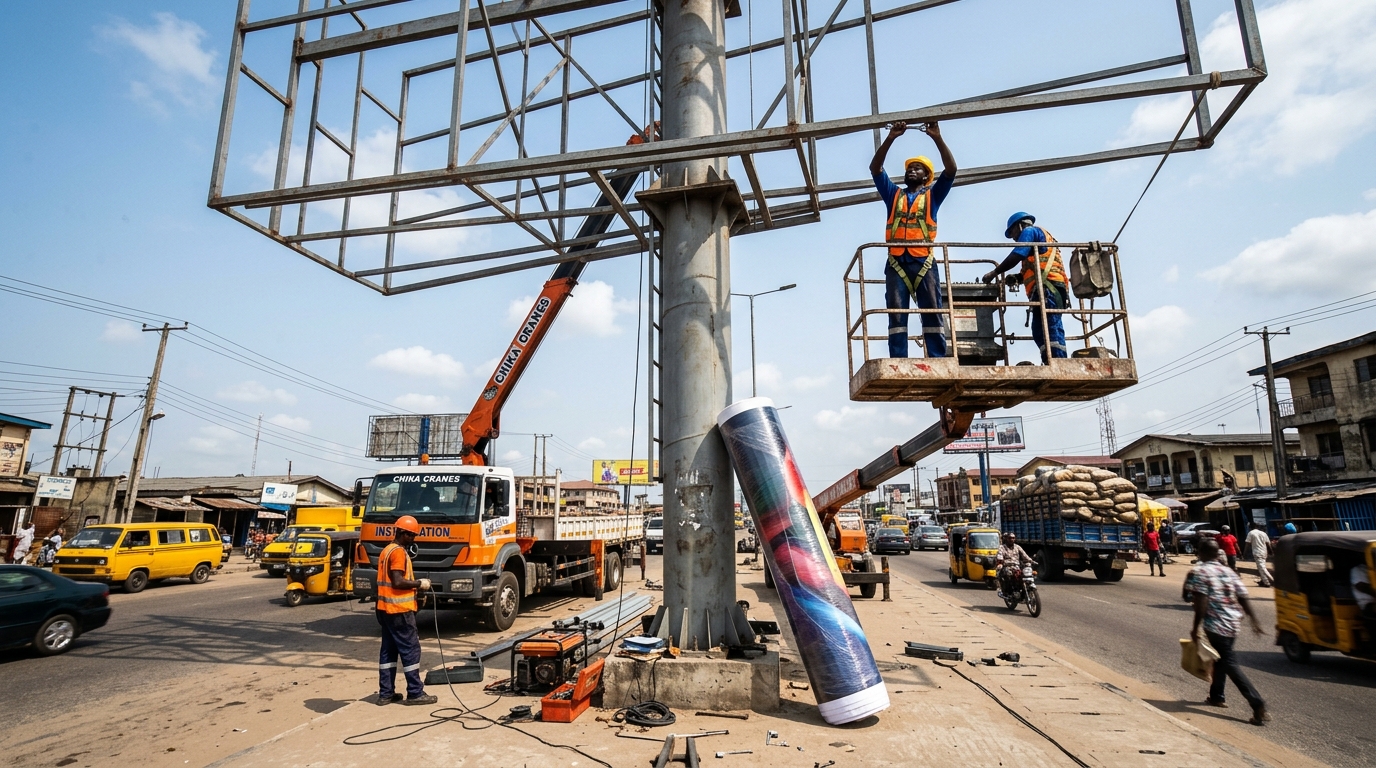
Stage 4: Physical Installation and Mounting (1 to 2 Days)
The physical act of mounting a billboard is the fastest part of the process. A standard static board takes a professional installation crew between half a day and a full day to mount, depending on the structure type and height.
Factors that can extend installation time:
- Weather conditions, particularly heavy rain during Lagos wet season
- Access restrictions on certain roads or structures requiring permits
- Structural issues with the billboard frame that need repair before mounting
- Scheduling conflicts if the installation crew is handling multiple locations simultaneously
For LED billboards, there is no physical mounting of printed material. Content goes live digitally once uploaded and scheduled, which means Stage 4 effectively takes hours rather than days.
What the Total Timeline Looks Like End to End
Adding the four stages together produces the following realistic planning benchmarks:
| Campaign Type | Minimum Timeline | Realistic Timeline | Conservative Timeline |
| Single static board, Lagos or Abuja | 10 days | 14 to 18 days | 21 days |
| Single static board, secondary city | 12 days | 16 to 21 days | 25 days |
| Multi-city static campaign | 14 days | 21 to 28 days | 35 days |
| Single LED board (content only) | 3 days | 5 to 7 days | 10 days |
The minimum timelines assume no artwork revisions, no approval delays, and a vendor with an available installation crew. The conservative timelines account for the variables that commonly occur in Nigeria’s OOH market.
For any campaign tied to a fixed launch date, plan against the conservative timeline and treat anything faster as a bonus.
Factors That Can Extend Your Billboard Installation Timeline
Beyond the standard stages, several Nigeria-specific variables regularly extend campaign timelines:
ARCON backlog periods
During high-demand periods such as election seasons, festive periods, and major product launch cycles, when many brands are advertising simultaneously, ARCON processing times increase. Campaigns planned around these periods should add at least five to seven extra days to the approval estimate.
Vendor production capacity
Not all Nigerian billboard vendors have in-house printing facilities. Vendors who outsource printing to third-party facilities are subject to that facility’s queue. Ask your vendor directly whether they print in-house or outsource.
Rainy season in Lagos
Heavy rain between April and October slows outdoor installation work significantly. Vinyl mounting in wet conditions is not only more difficult but also risks print quality. Campaigns planned during the peak rainy season should build weather contingency into the installation timeline.
Structural readiness of the board
Occasionally, a billboard structure requires maintenance or repair before a new advertisement can be mounted. Reputable vendors identify and address this in advance. Always confirm the physical condition of the structure before signing a contract for a static board.
How to Plan Your Campaign Around the Installation Timeline

Practical steps for building a realistic campaign schedule:
- Confirm your intended go-live date first, before any other planning begins
- Work backward from that date using the realistic timeline benchmarks above
- Set your artwork submission deadline at least 21 days before the intended go-live date for a static campaign
- Confirm with your vendor that ARCON and any state-level approvals will be handled, and factor their estimated processing time explicitly into the schedule
- Build a five to seven days buffer between the vendor’s promised installation date and your intended go-live date
- Request installation confirmation photographs before announcing the campaign publicly
For campaigns tied to product launches, investor events, or seasonal windows, the conservative timeline is always the safer planning assumption. A billboard campaign that launches three days after a product launch is significantly less valuable than one that is live on launch day.
What Most Nigerian Brands Get Wrong About Billboard Timelines
Booking too late
The most common and preventable mistake. A billboard campaign with a fixed launch date needs to be booked at least three to four weeks in advance for a single-city static campaign, and five to six weeks in advance for a multi-city campaign.
Bookings made less than two weeks before an intended launch date are operating on hope, not planning.
Not confirming ARCON’s responsibility
Some vendors include ARCON processing in their service. Others charge it separately or expect the advertiser to manage it. Clarify this explicitly at the contract stage, not after a delay has already occurred.
Treating the vendor’s estimated timeline as a guarantee
In Nigeria’s OOH market, timelines are estimates shaped by variables outside any single party’s control. A vendor who promises a ten-day turnaround is telling you the best-case scenario. Plan for the realistic one.
Not building in artwork revision time
First-submission artwork is rarely the final version. Internal approvals, legal reviews, and vendor technical checks all take time. Advertisers who submit artwork on the last possible day have no margin for the revision cycle that almost always follows.
Frequently Asked Questions
How long does it take to install a billboard in Lagos specifically?
For a standard static billboard in Lagos, the realistic end-to-end timeline from artwork submission to installation is 14 to 18 working days.
Can a billboard campaign be set up in less than a week in Nigeria?
Rarely for static boards, and only under very specific conditions.
Who handles ARCON approval for my billboard campaign?
In most cases, the billboard vendor manages ARCON approval as part of their service.
What happens if my billboard is not ready by my campaign launch date? This depends on your contract terms. Most Nigerian OOH contracts count campaign duration from the date of installation, not from the originally planned go-live date. If the delay is on the vendor’s side, you should not lose campaign days. Confirm this in writing before signing.
Conclusion
Billboard installation in Nigeria is not a 48-hour process. It is a multi-stage operation involving artwork preparation, regulatory approvals, physical production, and on-site installation, each with its own timeline and its own potential for delay.
The brands that consistently get their campaigns live on time are not lucky. They are the ones who understand the process, plan against realistic timelines, and build enough lead time into their campaign schedule to absorb the variables that Nigeria’s OOH market regularly introduces.
Book early. Submit artwork to specification. Confirm ARCON responsibility upfront. Build a buffer. And never plan a billboard campaign with a fixed launch date against a best-case timeline.
Oxbillboards helps Nigerian brands navigate the full OOH process with verified inventory, transparent location data, and the kind of structured campaign planning support that turns billboard timelines from a source of anxiety into a manageable, predictable part of every campaign.