

A Comprehensive Guide to Formats, Dimensions, Visibility, and Strategic Use Cases
Billboard advertising is one of the most powerful channels for outdoor marketing in Nigeria. Its effectiveness begins with a key decision:
What size billboard to use?
Billboard size affects how far your message travels, how well it can be read, how much it costs, and how it aligns with your campaign objectives.
This article provides an in‑depth explanation of the wide range of billboard sizes in Nigeria, how they are measured, where each is best placed, and how to match size to marketing strategy. It includes real examples, common formats, and detailed use cases to help advertisers make informed decisions.
Understanding Billboard Size
When marketers talk about billboard size, they refer to the physical dimensions of the advertisement surface that viewers see. Billboards come in standardized formats that determine visibility, creative requirements, and exposure quality.
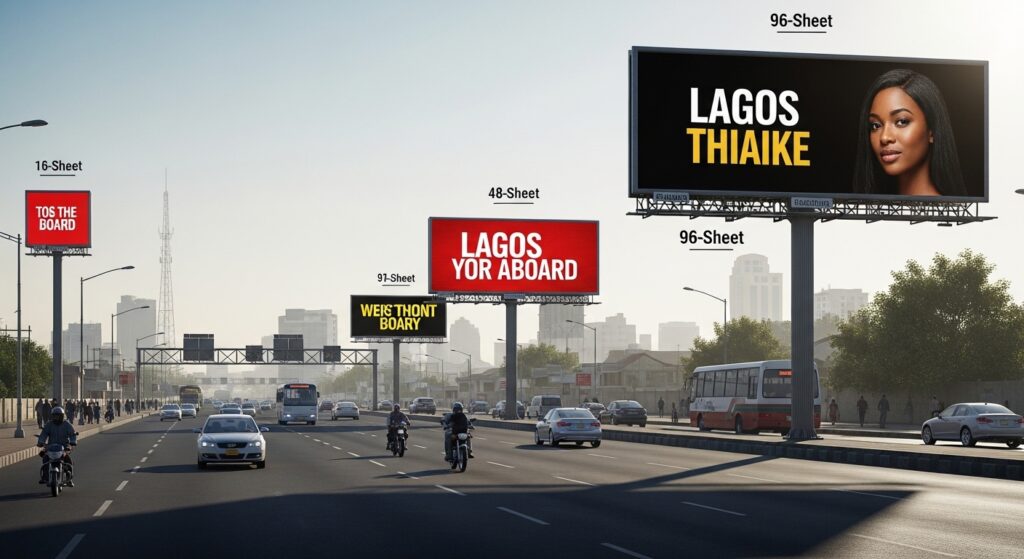
In Nigeria, common billboard sizes use traditional naming conventions such as “16 sheet”, “48 sheet”, and “96 sheet.” These terms originated from panel systems used to build large outdoor displays. Over time, these formats became standard language in the industry.
Size matters because it determines how far away the message can be seen, how much content can be displayed in a clear and legible way, and how the billboard interacts with the environment around it.
Common Billboard Sizes Used in Nigeria
Billboard sizes in Nigeria cover a wide range. Each size has specific benefits and recommended placement contexts based on traffic patterns and audience visibility.
16‑Sheet Billboard
Approximate Size: 2 meters high by 3 meters wide
The 16‑sheet format is one of the smaller standard billboard sizes. It is typically used in areas where:
-
Traffic moves slowly
-
Pedestrians are frequent
-
Vehicles are close to the billboard face
-
Local or neighborhood audiences are the main target
These boards are commonly seen near bus stops, urban intersections, markets, and inner city streets where people are close to the sign. A 16‑sheet board works well for concise messages with strong visuals and minimal text.
Advertisers use this format for campaigns such as:
-
Retail promotions for shops or malls
-
Local service advertising
-
Immediate call to action messaging
Because of its size, it is more affordable than larger formats and can be effective for targeted local reach.
48‑Sheet Billboard
Approximate Size: 3 meters high by 6 meters wide
This is the most widely used billboard size in Nigeria. The 48‑sheet board strikes a balance between visibility and cost. It is large enough to be seen clearly from moving vehicles but not so large that it becomes prohibitively expensive.
Typical placement locations include:
-
Major city roads
-
Busy commercial zones
-
Locations near shopping centers
-
Roads with moderate to heavy traffic
The 48‑sheet format supports more complex creative than smaller boards. Advertisers can include a headline, a supporting statement, a brand logo, and a call to action. This format is ideal for:
-
Mid‑tier retail campaigns
-
Product awareness messaging
-
Service advertising
-
Educational announcements
Because it is so common, many outdoor media owners have 48‑sheet structures available for rent across cities like Lagos, Abuja, and Port Harcourt.
96‑Sheet Billboard
Approximate Size: 3 meters high by 12 meters wide
The 96‑sheet format is a large billboard that dominates visual space. It is used when the goal is maximum visibility and impact. A 96‑sheet billboard can be seen from long distances and is often placed in areas where traffic moves quickly or where visibility needs to be strong even at high speeds.
Common placement zones for 96‑sheet boards include:
-
Expressways
-
Bridge approaches
-
Highways with long sightlines
-
Major commercial corridors
At this size, messages must be simple, bold, and easy to comprehend within seconds. The large space makes it possible to create a strong brand presence that cannot be ignored by daily commuters.
This format is often used by:
-
National brands seeking mass awareness
-
Telecom companies promoting network offers
-
Banks announcing new products
-
Government public service campaigns
Because of its scale and prominence, rental for 96‑sheet boards usually costs significantly more than smaller formats.
Beyond Sheet Formats: Large Structural Formats
In addition to standard sheet formats, outdoor advertising in Nigeria includes several large structural formats that do not fall neatly into the sheet naming system but are important due to their visual impact.
Unipole Billboards
A unipole billboard is a large advertisement mounted on a single tall metal pole. These billboards are anchored into the ground and elevated high above street level. Because of this elevation, unipole billboards are visible from long distances and across wide angles.
Key features of unipole billboards:
-
High elevation increases reach
-
Ideal for highways and open corridors
-
Viewed from far distances before the approach
Unipoles provide a strong branding presence for advertisers who want dominance in a landscape of visual clutter. In major cities like Lagos, unipoles are often found along highways or long expressways where visibility from far away gives brands extended exposure time with each viewer.
Gantry Billboards
Gantry billboards are large structures that span the width of a road, usually above traffic lanes. These formats provide cross‑direction visibility because vehicles approaching from either direction can see the message clearly.
A gantry structure is usually custom-built and requires engineering approval before installation. These boards are typically the largest outdoor formats and are premium placements because they:
-
Capture attention from all lanes of traffic
-
Provide extended viewing time
-
Serve as landmarks
Because of their size and structural complexity, gantry boards are more expensive to install and rent than standard sheet billboards.
Wallscapes and Building Facade Billboards
Some billboard formats in Nigeria are mounted directly on the side of buildings. These are often referred to as wallscapes or wall drapes. They do not follow a standard sheet measurement because the size depends on the available facade.
Wallscapes are common in:
-
High‑density urban centers
-
Commercial districts with tall buildings
-
Areas where traditional billboard structures cannot be installed
These formats are valuable for campaigns targeting both street audiences and upper‑level building sightlines.
Digital Billboard Sizes
In recent years, digital billboard technology has changed outdoor advertising. Digital screens use LED panels to display rotating ads. Because they are electronic, digital billboards can handle multiple creatives in the same physical structure.
Digital billboards generally follow the physical footprint of standard sizes, such as:
-
Digital 48‑sheet billboards
-
Digital 96‑sheet billboards
-
Large unipole LED screens
The difference between static and digital formats lies in content delivery and flexibility rather than pure size. LED screens allow advertisers to change messages in real time, schedule ads by time of day, and display motion content that attracts higher viewer attention.
How Size Influences Campaign Goals
The choice of billboard size depends on the campaign objective and audience context. Below are common scenarios:
For Mass Awareness
Large formats such as 96‑sheet, gantries, and LED unipoles are most effective because they dominate visuals and reach a broad audience. These formats are ideal for:
-
Brand launches
-
National campaigns
-
Product awareness on major networks
Large boards create a presence that smaller formats cannot match.
For Urban and Local Reach
Medium formats such as 48‑sheet boards and wallscapes work well in urban centers where traffic flows slow enough for viewers to absorb the message. These are suitable for:
-
Retail promotions
-
Local services
-
Event announcements
This size offers a balance between visibility and cost.
For Close Proximity Advertising
Smaller formats like 16‑sheet and street pole boards target audiences at close range. These are useful for:
-
Neighborhood businesses
-
Directional messaging
-
Short‑term promotions
Smaller sizes are cost‑effective and engaging when drivers or pedestrians are near the advertisement.
Cost Considerations and Size
Billboard size directly influences cost in any outdoor advertising market, including Nigeria:
-
Larger formats cost more to produce and install
-
Bigger structures require stronger fabrication
-
Elevated structures need engineering and safety compliance
-
Digital boards often have higher rental fees
For example, a 96‑sheet billboard has higher material and installation costs than a 48‑sheet board. Gantry billboards cost more than standard sheet formats because of structural complexity. Digital screens require technology investment over static prints.
Advertisers must align size choice with budget and campaign impact expectations.
How Standard Sizes Relate to Media Formats
Billboard names such as “16‑sheet” or “48‑sheet” are shorthand for surface area. Behind these labels is a system of standardized panels that can also be translated into feet or meters based on local conventions.
For example:
| Sheet Term | Approx Width × Height |
|---|---|
| 16 Sheet | ~2m × ~3m |
| 48 Sheet | ~3m × ~6m |
| 96 Sheet | ~3m × ~12m |
Creative Design Strategies by Size
Billboard creative must be tailored to size for maximum effectiveness:
-
Large Formats: Big visuals, short headlines, strong contrast colors, and simple branding elements.
-
Medium Formats: Balanced text and visuals that are easy to read from moving vehicles.
-
Small Formats: Simple graphics with minimal text and bold calls to action.
Billboards are typically viewed from moving vehicles. Messages are absorbed quickly. Design should account for limited viewing time.
Placement Strategies for Sizes
The location of a billboard interacts with its size to determine visibility and impressions:
-
Expressways: Use large formats where vehicles move fast, and sightlines are long.
-
Inner City Roads: Use medium and small formats where vehicles move more slowly, and viewers are closer.
-
Pedestrian Zones: Use smaller boards where foot traffic is primary.
Strategic placement ensures that each size delivers the greatest possible impact for the audience.
Summary
Billboard advertising in Nigeria includes a range of sizes that serve different strategic purposes:
-
16‑Sheet: Small, urban, local engagement
-
48‑Sheet: Standard medium visibility
-
96‑Sheet: Large dominance on highways
-
Unipoles: Elevated, long‑range visibility
-
Gantry: Cross‑direction visibility
-
Wallscapes: Building‑mounted, large surface
-
Digital: Flexible message rotation on LED screens