

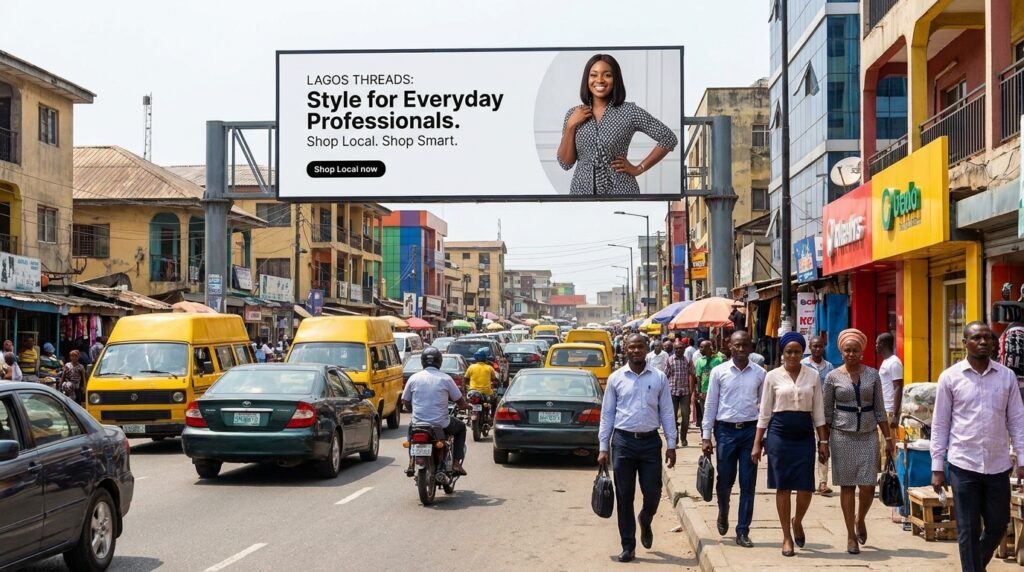
The assumption that billboard advertising is reserved for big brands with massive marketing budgets is one of the most persistent misconceptions in Nigerian business. Walk past any ten billboards in Lagos, and you will likely see a mix of multinational brands, growing Nigerian companies, and small businesses that understood something many of their peers have not: you do not need a Dangote-sized budget to run an effective outdoor campaign.
This guide is written specifically for Nigerian SME owners and marketing managers who want a practical, honest breakdown of how billboard advertising works at a range of budget levels.
What Does Billboard Advertising Actually Cost in Nigeria?
The first step is to understand the actual cost landscape. Billboard advertising in Nigeria spans a very wide range, and most of the premium pricing you have likely seen quoted applies only to the most sought-after locations in Lagos Island and the Lekki corridor.
Entry-Level Placements (N400,000 to N800,000 per month)
These are smaller-format boards in high-density but non-premium locations: internal community roads in Ikorodu, Akowonjo, Agege, Oshodi, and commercial routes in secondary cities like Aba, Ibadan, and Ilorin. For a local SME serving a defined community, these boards can deliver exceptional value. You can explore affordable Lagos Mainland options in the Ox Billboards Mainland listings.
Mid-Range Placements (N800,000 to N2 million per month)
This range covers a substantial portion of the available billboard inventory in Lagos Mainland, Abuja’s secondary corridors, and the main commercial zones of cities like Ibadan, Enugu, and Port Harcourt. A well-positioned mid-range board delivers strong daily impressions without the premium pricing of the Lekki expressway or Awolowo Road, Ikoyi.
Premium Placements (N2 million and above per month)
These are the iconic sites on Lagos Island, the Lekki expressway, Ahmadu Bello Way in Victoria Island, and equivalent premium corridors in Abuja and Port Harcourt. These are the locations that national brands compete for, and they are priced accordingly.
For most Nigerian SMEs, the entry-level to mid-range categories represent the practical opportunity, and they are larger than most business owners realise.
Strategy 1: Target Your Immediate Community
The most cost-effective billboard approach for a Nigerian SME is hyper-local targeting. Rather than trying to reach all of Lagos, focus your outdoor spend on the specific areas where your existing and potential customers live and travel daily.
A restaurant in Gbagada does not need a billboard on the Third Mainland Bridge. It needs a well-positioned board on a busy Gbagada road that its target customers see on their morning and evening commute. A school in Maryland does not need visibility on the Lekki expressway. It needs presence on the internal roads of the communities it serves.
This kind of community-level outdoor targeting is exactly where entry-level billboard pricing applies. You are not competing with large national brands for a prime Lagos Island spot; you are securing a well-located community board in front of the specific people most likely to become your customers.
Strategy 2: One Board, Run Long

One of the most common mistakes SMEs make when they enter outdoor advertising is booking multiple sites across multiple locations to replicate what large brands do. For most SME budgets, this dilutes the impact and reduces the duration.
A more effective strategy is to concentrate your entire OOH budget on one well-chosen location and run it for a sufficient duration. A single board on the right road, visible to the same audience every day for three months, will almost always outperform three boards spread across three different locations for one month each.
Frequency is what builds brand familiarity. A commuter who sees your billboard twice a day, five days a week, for twelve weeks has seen it over 100 times. That repetition is what moves a brand from unknown to recognised to trusted.
Strategy 3: Choose Locations Close to Your Business
For retail businesses, service providers, and any SME where the customer needs to physically visit, proximity to your business is one of the most important selection criteria.
A billboard within two kilometres of your business, on a well-trafficked road leading toward you, functions as a directional prompt that reduces the distance between awareness and action. The consumer sees the board, remembers it when they are in the area, and makes the connection between your advertising and your physical presence.
Strategy 4: Negotiate Duration for Better Rates
Most Nigerian billboard vendors are open to negotiation, particularly for longer commitments. The standard rate card represents the highest per-month price you pay for a single-month booking. Brands that commit to six or twelve months typically achieve meaningful discounts.
For an SME working with a limited budget, a twelve-month commitment to a mid-range board at a discounted rate often provides better value than a series of short-term campaigns at full rate. Ask your vendor specifically about annual rates and early payment incentives.
Strategy 5: Pair Your Billboard with a Strong Digital Presence
As covered in our article on how billboard advertising boosts Google search traffic, billboards consistently drive branded Google searches. For an SME, this means your digital presence must be ready to capture that interest.
At minimum, ensure your Google Business Profile is complete and current, your website is functional and mobile-friendly, and your social media presence is consistent with the brand identity on your billboard. These are not optional extras; they are the infrastructure that converts billboard-generated curiosity into actual customers.
Strategy 6: Track Your Results
Outdoor advertising can be measured more than most SMEs realise. Simple, practical tracking approaches include:
- Asking new customers how they heard about you and recording the responses systematically over the campaign period.
- Monitoring branded searches in Google Search Console for an uplift that correlates with your campaign launch date.
- Including a unique offer code on your billboard creative to enable direct sales attribution from the outdoor campaign.
A Practical Example: What an SME Campaign Looks Like
To make this concrete, consider a fashion boutique in Lekki Phase 1 with a three-month outdoor budget of N1.2 million. At a negotiated rate of N400,000 per month, the brand secures a well-positioned board on Admiralty Way for the full three months.
The target customer, an affluent Lekki resident, sees the board on their daily commute. Over the campaign period, the same individual will have seen the board dozens of times. Brand familiarity builds.
When they are next in the market for a fashion purchase, this boutique is in their consideration set in a way it was not before the campaign.
This is realistic, affordable, and achievable for a small business with a deliberate marketing budget. The key is combining the right location, the right duration, and sufficient creative quality to make the board worth remembering. For location ideas, browse the full listings at Ox Billboards or reach out to discuss a plan tailored to your business.