

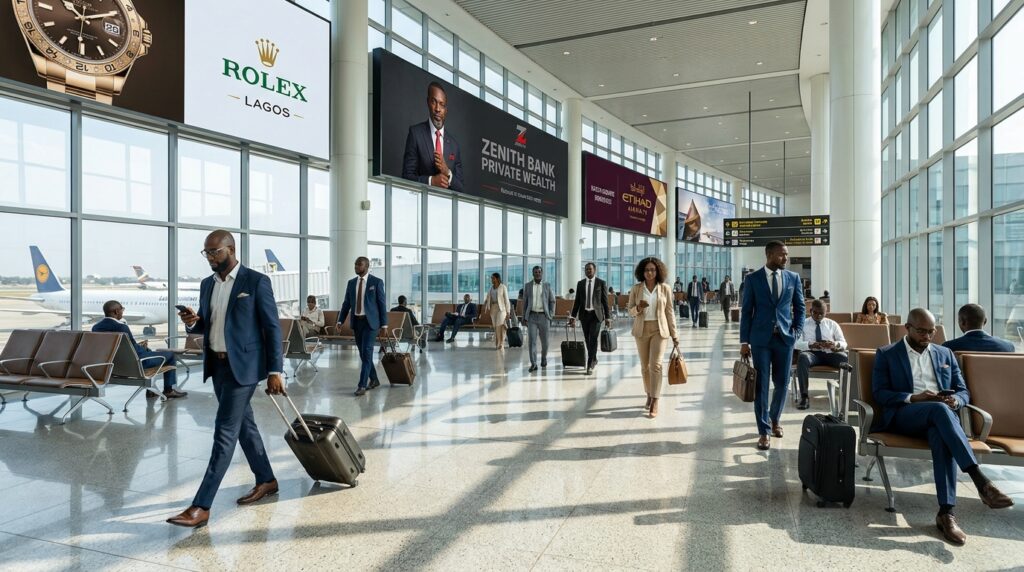
Airport advertising in Nigeria occupies a unique position in the outdoor advertising market.
It combines the scale of traditional billboard exposure with a captive, high-value audience that includes business travellers, frequent flyers, government officials, and corporate decision-makers who are genuinely difficult to reach through most other channels.
If your brand has been considering an airport advertising campaign in Nigeria, this guide covers the essentials: where the key placements are, what they typically cost, who the audience is, and what to expect from your investment.
Why Airport Advertising Works
The core strength of airport advertising is the quality of its audience. Not everyone drives past a particular highway billboard, but everyone in an airport has made a deliberate decision to be there.
They have planned a journey, often in advance, and they tend to sit firmly in mid-to-high-income demographics.
Research from the Airports Council International shows that airport advertising achieves some of the highest brand recall figures in the entire OOH category.
A large part of that recall comes from dwell time. A Nigerian airport traveller may spend 60 to 180 minutes in or around a terminal on a single trip. That is an extended, immersive brand contact window that roadside billboards simply cannot replicate. There is no fast-forwarding, no scrolling, and no ad blocker.
Key Airport Advertising Locations in Nigeria
Murtala Muhammed International Airport, Lagos
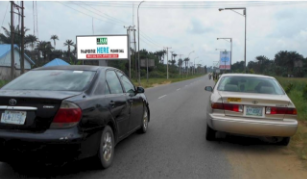
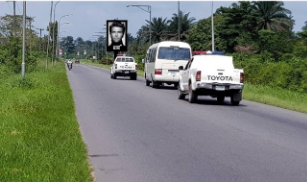
Lagos remains Nigeria’s busiest aviation hub. Advertising opportunities around MMIA include large-format billboards along Airport Road in Ikeja, placements near and around the MMA2 terminal, and wall branding visible on the approach roads.
For an overview of available Lagos airport corridor boards, browse the Ox Billboards Ikeja listings. Brands advertising around MMIA reach the highest volume of air travellers in Nigeria, alongside the broad residential and professional community of the Ikeja and Maryland axis.
Nnamdi Azikiwe International Airport, Abuja
Abuja’s international airport serves Nigeria’s federal capital and its dense concentration of government officials, civil servants, diplomats, and executives.
Airport road advertising in the FCT reaches this premium demographic both on arrival and on departure, making it particularly valuable for brands in financial services, corporate technology, and government-facing categories.
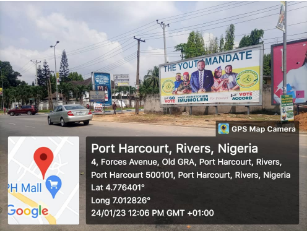
Port Harcourt International Airport
Port Harcourt’s airport serves one of Nigeria’s most commercially important cities, driven by the oil and gas sector. A significant proportion of airport traffic here consists of oil company executives, expatriate professionals, and high-income industry workers.
For B2B brands and premium consumer brands targeting the South-South region, Port Harcourt airport advertising delivers an audience quality that is difficult to match elsewhere.
Other Notable Airports
Ilorin, Enugu, Calabar, Owerri, and Kano airports all offer outdoor advertising opportunities with varying levels of traffic and audience concentration. These are typically more affordable than Lagos and Abuja and can be effective for brands with regional targeting objectives or national campaigns that want a consistent presence across multiple city pairs.
What Does Airport Advertising Cost in Nigeria?
Airport advertising costs in Nigeria vary based on location, format, duration, and whether the placement is indoor or outdoor.
Here is a practical cost guide for 2026:
Airport Road Billboards (Outdoor, Roadside)
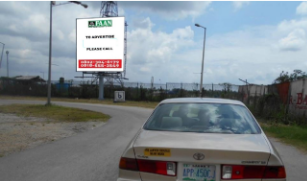
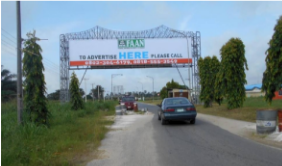
These are the most accessible forms of airport advertising for most Nigerian brands. A large-format static billboard on Airport Road in Ikeja typically costs between N1.5 million and N3.5 million per month, depending on size, exact position, and the vendor.
These boards reach both travellers and the large daily non-travelling commuter population on this corridor.
MMA2 Terminal Area and Indoor Placements
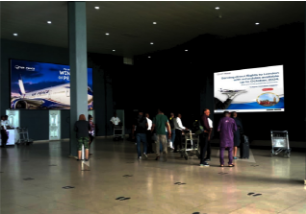
Digital and static boards inside or immediately around MMA2 carry premium pricing because of the captive indoor audience. Rates for these placements are negotiated directly with the Federal Airports Authority of Nigeria (FAAN) or their authorised advertising partners. Costs vary considerably based on format, position, and duration.
Abuja and Port Harcourt Airport Approach Roads
Similar in structure to Lagos, airport approach road boards in Abuja and Port Harcourt typically range from N600,000 to N2.5 million per month, depending on the exact position, format, and vendor.
Indoor vs. Outdoor Airport Advertising: Which Is Right for You?
Nigerian brands typically have a choice between outdoor billboard placements on airport approach roads and indoor placements within the terminals. Both have distinct advantages worth understanding.
Outdoor Airport Road Advertising
Outdoor reaches a wider audience, extending beyond travellers to include the thousands of daily commuters and commercial vehicle operators who use airport roads without flying.
It is more affordable and delivers higher raw impression volumes. For brands that need reach alongside premium audience access, outdoor is often the right starting point.
Indoor Airport Terminal Advertising
Indoor delivers a more captive, higher-value audience at a premium cost. Passengers waiting for flights have nowhere to go and nothing to do except observe their environment.
For luxury brands, financial services, and any category where the affluent business traveller is the primary target, the premium for indoor placement is typically justified.
For most Nigerian brands, a combination of outdoor airport road boards and selective indoor placements, where budget allows, provides the best balance of reach and audience quality.
How to Plan an Effective Airport Advertising Campaign
A few practical principles make the difference between an airport advertising campaign that builds real brand recognition and one that simply occupies a space.
Define Your Audience First
If you are targeting business travellers and executives, Port Harcourt or Abuja airport corridors may deliver better audience quality for your specific category than raw volume.
If you need broad awareness alongside premium positioning, Lagos Airport Road provides both.
Think Beyond the Terminal
Airport road corridors in Lagos, Abuja, and Port Harcourt are among the most consistently trafficked roads in each city. Your airport advertising placement reaches not only travellers but also the residential and corporate communities lining those routes. You can see specific examples on our billboard advertising page.
Commit to Sufficient Duration
Airport advertising works best over a minimum of three months. This allows sufficient frequency among the regular business travel audience. Single-month campaigns can work for event-specific activations, but rarely build the lasting brand recall that justifies the investment.
Work with a Licensed Vendor
Ensure your airport advertising partner is fully licensed with ARCON and compliant with FAAN regulations for any placements in or around airport facilities. Unlicensed boards are subject to removal without notice, which can disrupt an active campaign with no recourse.
Is Airport Advertising Right for Your Brand?
Airport advertising in Nigeria delivers maximum value for brands in financial services, aviation, hospitality, technology, luxury goods, and any category where the high-income, frequently travelling professional is a primary target.
For mass-market consumer brands looking to maximise raw reach, airport advertising works best as one element of a broader OOH strategy rather than the centrepiece. In those cases, high-volume expressway and market-area billboards deliver more impressions per naira.
The key is to treat airport advertising as a precision tool: powerful when pointed at the right audience. If you want to discuss which airport advertising placements make sense for your brand and budget, get in touch with Ox Billboards, and we will help you plan a campaign that delivers.