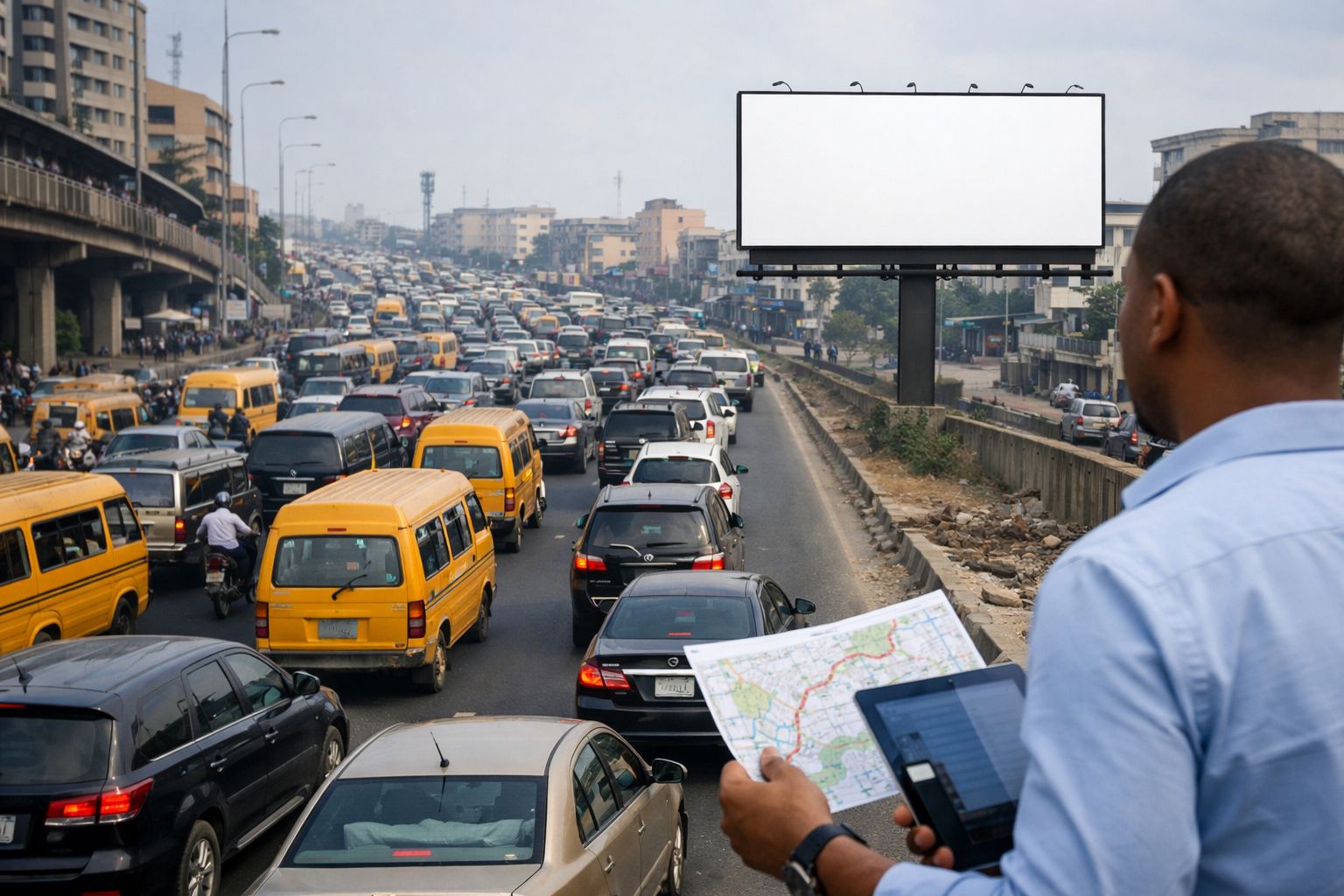


You’ve been quoted one price for 20 lamp posts in Lagos. Then another agency gives you a completely different figure for what looks like the same thing. So what’s the real cost?
In a city where traffic is heavy and visibility is competitive, understanding the cost of lamp post advertising in Lagos is not just about price per pole, it’s about location value, route dominance, compliance, and strategy.
If you’re planning a 2026 campaign, this guide breaks down what lamp post ads typically cost in Lagos, what truly influences pricing, how it compares to billboards, and how to budget intelligently so you don’t waste visibility or overspend on the wrong corridors.
What Is the Cost of Lamp Post Advertising in Lagos in 2026?
The cost of lamp post advertising in Lagos in 2026 depends largely on where you advertise, how many poles you book, and how long your campaign runs. Unlike fixed-rate digital ads, outdoor pricing reflects traffic value, commercial importance, and regulatory structure.
In Lagos, not all roads carry the same weight. A pole on Admiralty Way does not cost the same as one on a quieter inner street. Understanding these tiers helps you budget realistically.
Average Cost Per Lamp Post in Lagos
Lamp post ads in Lagos are typically priced per pole, per month. While exact rates vary by provider and route, pricing generally falls into three categories:
Prime Commercial Corridors
Locations such as Lekki Phase 1, Victoria Island, Ikeja GRA, and major business districts command premium rates. These areas have:
- High vehicle traffic
- Strong commercial activity
- Brand-heavy competition
- Longer traffic hold-up time
Because visibility is stronger, pricing reflects that demand.
Mid-Tier Locations
These include busy but slightly less premium corridors within Surulere, Yaba, Ogba, and parts of Ikeja. Traffic remains strong, but commercial density may be lower than in top-tier zones.
Rates here are more moderate while still delivering meaningful exposure.
Secondary Roads
These are lower-traffic routes or inner streets. Pricing is lower, but the visibility impact may also be reduced.
Brands that prioritize price over placement often choose secondary roads and later realize the exposure does not match expectations.
Monthly vs Short-Term Campaign Pricing
Most lamp post advertising in Lagos is structured monthly.
Short-term bookings (for example, 2–3 weeks) may not always reduce costs proportionally because installation, printing, and logistics still apply. In many cases, a full-month booking provides better value.
Longer campaigns may also allow for negotiation flexibility, especially when booking larger quantities.
Bulk Booking and Route Dominance Pricing
Lamp post advertising works best through repetition.
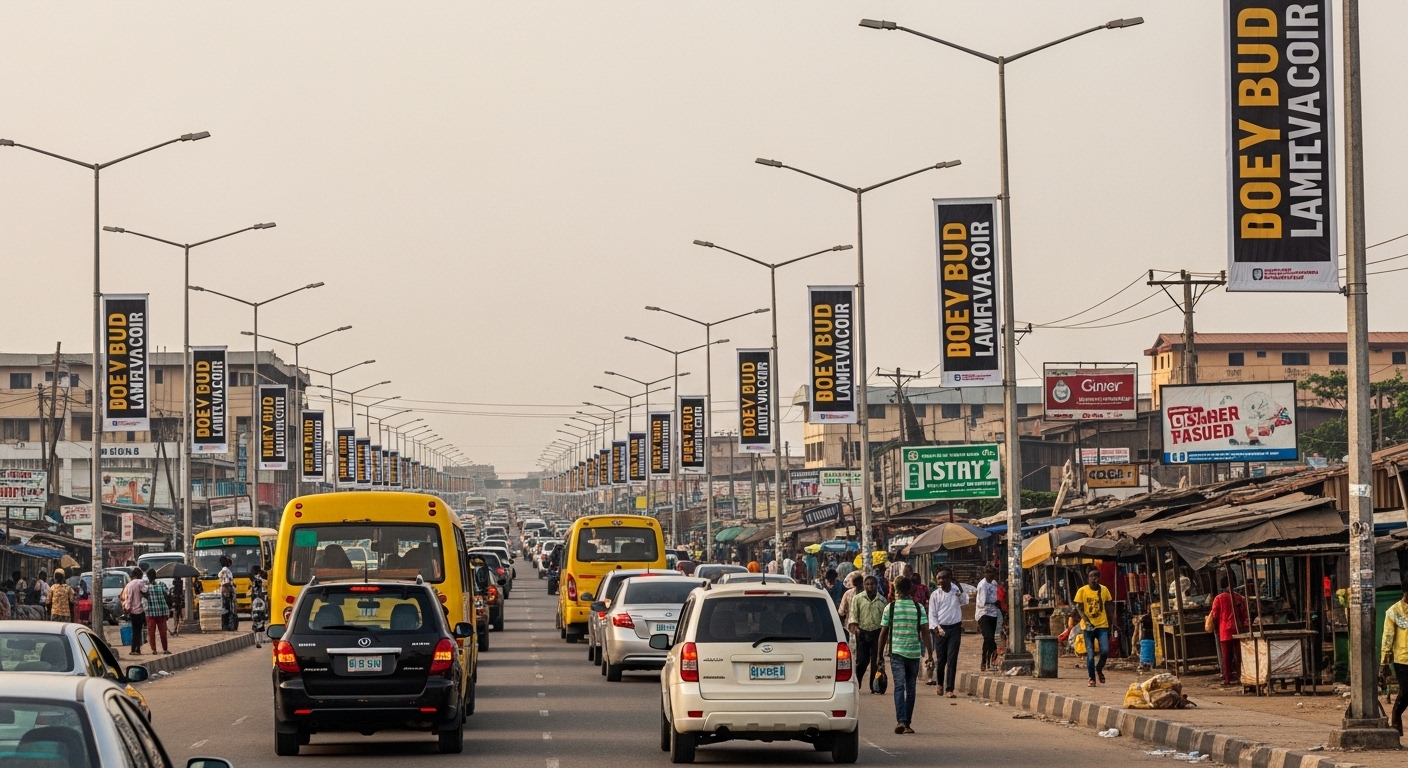
Booking 5 scattered poles across Lagos rarely creates an impact. Booking 30–50 poles along a single high-traffic corridor creates dominance.
Bulk bookings often:
- Reduce per-pole cost
- Improve brand recall
- Strengthen visibility within a defined route
The real question is not just “What is the cost per pole?” but “How much do I need to invest to own a corridor?”
That strategic difference separates weak campaigns from effective ones.
Average Cost of Lamp Post Advertising in Lagos (2026 Estimate)
| Location Tier | Example Areas in Lagos | Estimated Cost Per Pole (Monthly) | Visibility Level | Best For |
| Prime Commercial Corridors | Lekki Phase 1, Victoria Island, Ikoyi, Ikeja GRA, major expressways | ₦60,000 – ₦160,000 | Very High | Brand-heavy campaigns, product launches, premium positioning |
| Mid-Tier Commercial Routes | Surulere, Yaba, Maryland, Ogba, parts of Ikeja | ₦40,000 – ₦60,000 | High | Retail awareness, SME campaigns, balanced visibility |
| Secondary Roads / Emerging Areas | Inner residential-commercial streets, developing zones | ₦25,000 – ₦40,000 | Moderate | Hyper-local marketing, budget-conscious campaigns |
Additional Cost Components to Budget For
| Cost Component | What It Covers |
| Banner Production | Printing and finishing of lamp post banners |
| Installation Fees | Mounting and deployment on selected poles |
| Regulatory Permits | LASAA fees and ARCON compliance where required |
| Creative Design | Banner artwork development (if not already available) |
Sample Campaign Budget Illustration
| Scenario | Estimate |
| 40 poles in Lekki @ ₦70,000 per pole | ₦2,800,000 (media cost only) |
| Estimated production + compliance | ₦400,000 – ₦1,000,000 |
| Estimated Total Monthly Budget | ₦3.2M – ₦3.8M |
What Determines the Cost of Lamp Post Advertising in Lagos?
Two lamp posts in Lagos can look similar but deliver completely different results. That’s why pricing is never random. The cost of lamp post advertising in Lagos is driven by measurable planning factors, not just availability.
Before committing your budget, it’s important to understand what actually influences the rate you’re quoted.
Location Quality
Location is the strongest pricing driver.
A pole along Admiralty Way in Lekki or a busy stretch in Victoria Island carries a higher value because:
- Commercial activity is dense
- Brand competition is strong
- Audience purchasing power is higher
- Traffic congestion increases viewing time
On the other hand, inner streets with lighter movement will cost less but may also deliver weaker exposure.
In outdoor advertising, location strategy often matters more than the number of poles booked.
Traffic Volume
Traffic density directly affects exposure frequency.
A road where vehicles move slowly for long periods increases message retention. Commuters sitting in traffic are more likely to notice and process a repeated banner.
High-traffic corridors typically command higher rates because:
- Daily impressions are stronger
- Viewing time is longer
- Brand recall improves
When evaluating pricing, always ask: What is the daily traffic strength of this route?
Duration of Campaign
Lamp post advertising in Lagos is commonly structured on a monthly cycle.
Longer campaigns often allow:
- Negotiation flexibility
- Better placement stability
- Stronger brand recall
Short campaigns may not significantly reduce overall cost because production and installation still apply.
Consistency improves performance.
Quantity of Poles Booked
Lamp post ads rely on repetition.
Booking 10 poles across scattered areas weakens the impact. Booking 30–50 poles along one corridor creates route dominance.
Higher quantities can sometimes reduce the per-pole rate, but effectiveness should drive volume, not just discounts.
The goal is not just visibility. It is sustained repetition.
Regulatory and Permit Costs (LASAA & ARCON)
Outdoor advertising in Lagos operates within regulatory frameworks.
Campaigns typically require compliance with:
- LASAA (Lagos State Signage and Advertisement Agency)
- ARCON (Advertising Regulatory Council of Nigeria)
Permit processing, documentation, and compliance fees may influence total campaign cost. These charges vary depending on format, duration, and location.
Ignoring regulatory structure can lead to removals or penalties, increasing overall cost rather than reducing it.
Structured planning that accounts for regulatory requirements protects both budget and campaign continuity.
Lamp Post Advertising Cost vs Billboard Cost in Lagos
When planning outdoor campaigns, many brands ask the same question: Should we invest in lamp post ads or traditional billboards?
The answer depends on budget size, campaign objective, and the kind of visibility you want to achieve. While both formats fall under outdoor advertising in Lagos, their cost structure and performance dynamics are different.
Understanding this difference prevents budget misallocation.
Entry Budget Comparison
Lamp posts advertising in Lagos generally have a lower entry threshold.
Because pricing is structured per pole, brands can start with a moderate corridor booking rather than committing to one large-format board. This makes lamp post ads more accessible for:
- SMEs
- Retail businesses
- Event promoters
- Location-specific campaigns
Traditional billboards, especially in prime areas like Lekki or Victoria Island, require significantly higher upfront investment.
If your budget is limited, lamp post ads may allow you to dominate a smaller area rather than barely afford one large board.
Reach and Frequency Difference
Billboards are designed for scale. They offer wide visibility from a distance and are ideal for brand dominance.
Lamp post ads rely on repetition. Instead of one massive structure, they deliver multiple exposures along a corridor.
Here’s the difference in practical terms:
- A billboard may be seen once during a commute.
- A lamp post campaign may be seen 20 times within five minutes.
Frequency builds memory. Scale builds prestige. The right choice depends on campaign intent.
ROI Consideration
Return on investment depends on your objective.
If your goal is:
- Retail traffic to a specific area: Lamp post ads may deliver stronger localized ROI.
- Citywide brand awareness: Billboards often perform better.
- Premium positioning: Large-format boards create stronger visual authority.
- Event promotion along a route: Lamp posts reinforce message repetition.
Smart brands often combine both, using billboards for dominance and lamp posts for reinforcement.
Cost Comparison Table: Lamp Post Ads vs Billboards in Lagos
| Factor | Lamp Post Advertising | Traditional Billboard Advertising |
| Pricing Model | Per pole (monthly) | Per board (monthly) |
| Average Entry Budget | Lower | Higher |
| Best For | Corridor branding, events, retail | Brand dominance, mass awareness |
| Visibility Type | Eye-level repetition | Elevated large-format |
| Frequency | High (multiple exposures) | Moderate (single exposure per pass) |
| Scalability | Route-based expansion | City-to-city expansion |
| ROI Strength | Strong for localized impact | Strong for broad awareness |
| Factor | Lamp Post Advertising | Traditional Billboard Advertising |
| Pricing Model | Per pole (monthly) | Per board (monthly) |
| Average Entry Budget | Lower | Higher |
| Best For | Corridor branding, events, retail | Brand dominance, mass awareness |
| Visibility Type | Eye-level repetition | Elevated large-format |
| Frequency | High (multiple exposures) | Moderate (single exposure per pass) |
| Scalability | Route-based expansion | City-to-city expansion |
| ROI Strength | Strong for localized impact | Strong for broad awareness |
The key is not choosing the cheaper format. The key is aligning format with strategy.
In Lagos, where traffic density varies by corridor, structured planning determines whether your outdoor spend becomes visibility or waste.
What Most Brands Get Wrong About Lamp Post Advertising Budgets
Lamp post advertising in Lagos is not expensive when planned correctly. It becomes expensive when the strategy is weak.
Many brands focus only on the price per pole. But outdoor advertising is not a supermarket shelf. Cheaper does not automatically mean smarter.
Here are the most common budgeting mistakes.
Choosing Cheap Locations Over Strategic Corridors
A pole on a quiet inner street may cost far less than one in Lekki or Victoria Island. But if traffic is low, exposure drops.
Some brands reduce budget by choosing secondary roads, only to realize the campaign barely gets noticed.
In Lagos, visibility is driven by:
- Traffic density
- Commercial activity
- Route importance
- Audience concentration
Paying slightly more for a high-value corridor often delivers better returns than filling low-impact roads with banners.
Booking Too Few Poles
Lamp post advertising works through repetition.
Booking 8–10 poles scattered across different areas weakens recall. Commuters see the message once and forget it.
Effective campaigns usually:
- Cluster poles along a defined route
- Create visible dominance
- Reinforce the message multiple times within minutes
The goal is not just presence. It is frequency.
Ignoring Compliance Costs
Some advertisers focus only on media cost and forget regulatory expenses.
In Lagos, outdoor advertising involves oversight from LASAA and compliance with ARCON standards. Permit fees and documentation should be part of your budget planning.
Failure to factor this in can result in:
- Unexpected extra costs
- Delays in deployment
- Removal of materials
Compliance is not optional. It is part of structured planning.
Treating It as a Standalone Channel
Lamp post advertising in Lagos performs best when integrated into a broader OOH strategy.
Using lamp posts alone for a major product launch may limit scale. Combining them with:
- Static billboards
- LED boards
- Digital media
creates layered visibility.
Outdoor works strongest when formats reinforce each other.
How to Plan a Cost-Effective Lamp Post Campaign in Lagos
Cost-effective does not mean cheap. It means optimized.
With the right structure, lamp post advertising can deliver strong exposure without unnecessary waste. The key is disciplined planning.
Define Campaign Objective
Start with clarity.
Are you trying to:
- Drive traffic to a new store?
- Promote an event?
- Launch a product?
- Strengthen brand awareness in a specific area?
Objective determines location choice, number of poles, and duration.
Select Strategic Clusters
Instead of spreading poles across different neighborhoods, focus on one or two strong corridors.
For example:
- A retail brand in Lekki should dominate roads leading into its store.
- An event at Eko Convention Centre should own surrounding routes.
Clustering increases repetition and improves recall.
Integrate with Billboards
Lamp post ads reinforce. Billboards dominate.
If budget allows, combine both. A billboard builds authority. Lamp posts strengthen frequency along feeder roads.
This layered approach improves overall ROI.
Work With Verified Inventory Platforms
Lagos has a fragmented OOH landscape. Inventory is owned by different operators across various routes.
Working with structured, verified inventory platforms helps you:
- Compare locations clearly
- Understand traffic value
- Ensure compliance alignment
- Coordinate multi-route campaigns
- Avoid duplication or misinformation
Transparent planning improves cost control.
When pricing, compliance, and location strategy are aligned, lamp post advertising in Lagos becomes predictable, measurable, and more effective.
FAQs
How much does lamp post advertising cost in Lagos in 2026?
The cost of lamp post advertising in Lagos typically ranges between ₦25,000 and ₦100,000 per pole per month, depending on location quality, traffic volume, and route demand.
Is lamp post advertising cheaper than billboards in Lagos?
Yes.
What determines lamp post advertising rates in Lagos?
Several factors influence pricing like, location quality, traffic density, duration of campaign, number of poles booked, and regulatory and permit requirements
Do lamp post ads require LASAA approval?
Yes.
How many lamp posts should I book for effective visibility?
There is no universal number, but effective campaigns often involve 20–50 poles within a single corridor to create dominance and repetition.
Is lamp post advertising effective for small businesses?
Yes, especially for retail businesses, event promotions, location-based marketing, and SMEs targeting specific neighborhoods
Conclusion
The cost of lamp post advertising in Lagos is not just about the price per pole. It is about traffic value, location strategy, compliance structure, and repetition.
Brands that focus only on the cheapest rates often underperform. Brands that plan corridors strategically see stronger recall and better returns.
In a complex and fragmented outdoor advertising environment like Lagos, clarity matters. Verified inventory, transparent pricing, and structured planning reduce uncertainty and protect your budget.
If you’re planning a 2026 campaign, the smartest investment is not just in poles, it’s in strategy.
READ MORE:
What are the Costs of Billboard Advertising in Nigeria?
The Role of Lamp Post Ads in Billboard Advertising