


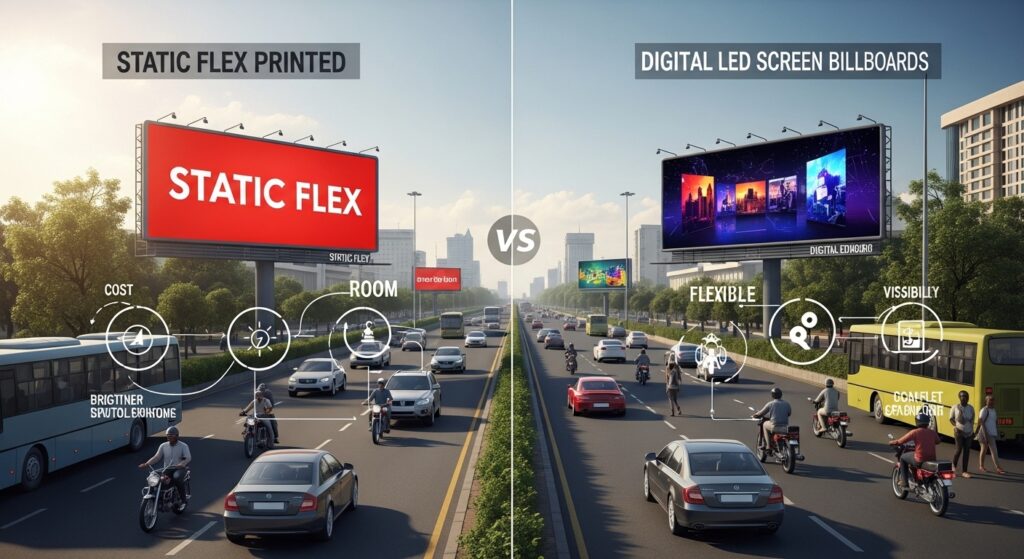
Outdoor advertising has long been one of the most dominant and resilient forms of marketing. Despite the rise of digital marketing channels, billboards continue to command attention in physical environments where consumers live, commute, shop, and socialize. However, the industry has evolved dramatically. What was once exclusively a print-based medium has expanded into high-resolution LED ecosystems capable of delivering dynamic, data-driven messaging.
Today, advertisers must choose between two fundamentally different formats:
-
Static billboards, built on traditional print production
-
Digital LED screen billboards, powered by electronic display systems
While both formats occupy physical space in high-traffic areas, their operational structure, creative capabilities, financial models, data integration, maintenance requirements, and long-term strategic value differ significantly.
This in-depth guide provides a fully expanded examination of the 15 biggest differences between static and digital LED billboards, helping brands, agencies, property owners, and investors make informed strategic decisions.
How Static and Digital Billboards Actually Work
Understanding the underlying mechanics of each format is essential before comparing performance and return.
Static Billboards
A static billboard is a large-format advertisement printed onto vinyl, PVC, mesh, or paper and mounted onto a structural frame. The creative remains unchanged until it is manually replaced.
Production Workflow
The lifecycle of a static billboard includes several coordinated stages:
-
Creative concept development
-
Graphic design optimized for distance visibility
-
Large-format printing on weather-resistant materials
-
Finishing and reinforcement of edges
-
Transportation to the installation site
-
Physical mounting using cranes or lifts
-
Alignment, tensioning, and inspection
Every update restarts this process.
Structural Simplicity
Static boards are mechanically straightforward:
-
Steel or aluminum framework
-
Printed substrate
-
External floodlighting for night visibility
There are no processors, no software, and no connectivity requirements. This simplicity contributes to reliability and longevity.
Digital LED Screen Billboards
Digital billboards operate as programmable outdoor display systems.
They consist of:
-
LED modules arranged in pixel matrices
-
Control processors that manage image rendering
-
Content management software for remote scheduling
-
Power supply systems
-
Cooling mechanisms
-
Network connectivity for updates and data integration
Each pixel is composed of red, green, and blue diodes that combine to produce millions of color variations.
Operational Ecosystem
Digital billboards function as:
-
Media platforms
-
Software-driven advertising systems
-
Revenue-optimized rotating inventory
They require continuous electrical power and periodic technical maintenance but offer dramatically expanded capabilities.
The 15 Big Differences Between Static and Digital LED Billboards
1. Display Technology and Image Rendering Capabilities
Static billboards rely on a fixed printed image. The quality depends entirely on printing resolution, material durability, and external lighting conditions.
Digital billboards generate images electronically using LED pixels. They can display:
-
Still images
-
Animated graphics
-
Full-motion video
-
High-contrast color transitions
Why This Difference Is Foundational
Technology influences:
-
Brightness intensity
-
Color vibrancy
-
Daytime visibility
-
Nighttime clarity
-
Ability to animate
Digital screens maintain consistent brightness regardless of ambient lighting conditions, while static boards rely on floodlights at night and sunlight during the day.
2. Content Flexibility and Message Control
Static boards are inherently fixed. Once installed, the message cannot change without physical intervention.
Updating requires:
-
New artwork
-
Reprinting
-
Installation crew scheduling
-
Removal and reinstallation
This creates time delays and added cost.
Digital billboards allow content to be changed remotely through cloud-based dashboards.
Operational Impact
Digital systems enable:
-
Immediate campaign adjustments
-
A/B creative testing
-
Multiple product showcases
-
Seasonal rotations
-
Real-time corrections
Flexibility transforms digital billboards into responsive media tools rather than static announcements.
3. Campaign Launch Speed and Market Responsiveness
Static billboard deployment involves production timelines. Even minor updates require printing and physical labor.
Digital billboards eliminate these logistical barriers.
Creative can be:
-
Uploaded instantly
-
Scheduled in advance
-
Triggered automatically
-
Modified mid-campaign
For industries like retail, entertainment, sports, and events, speed is often the deciding factor.
4. Message Rotation and Inventory Structure
Static billboards operate on a single-tenant model. One advertiser occupies the space for the duration of the contract.
Digital billboards operate on a multi-tenant rotation model.
How Rotation Works
Ads cycle every few seconds, typically featuring multiple advertisers in a loop.
This enables:
-
Shared visibility
-
Shorter campaign durations
-
Flexible pricing tiers
For media owners, digital boards dramatically increase revenue density per location.
5. Cost Structure and Financial Planning
Static billboards typically offer lower rental fees but require recurring production expenses for each new campaign.
Digital billboards charge higher placement fees due to:
-
Infrastructure investment
-
Electricity consumption
-
Software licensing
-
Maintenance costs
However, digital eliminates repeated printing and installation costs.
Long-Term Financial Analysis
If a brand runs one stable campaign for several months, static may be more economical.
If a brand rotates promotions regularly, digital can reduce cumulative production expenses.
6. Visual Attention and Psychological Engagement
Human attention is influenced by movement, light intensity, and color contrast.
Static billboards rely on bold, simplified design to maximize clarity in brief viewing windows.
Digital billboards use:
-
Motion
-
Sequential messaging
-
Bright LED illumination
-
Dynamic transitions
In crowded urban environments, motion often increases noticeability and memory retention.
7. Creative Freedom and Storytelling Depth
Static design demands simplicity. The entire message must fit into one still frame.
Digital screens allow:
-
Multi-scene narratives
-
Video storytelling
-
Animated logos
-
Product demonstrations
-
Countdown clocks
-
Interactive-style sequences
This expanded creative bandwidth allows advertisers to communicate more complex messages without overwhelming viewers.
8. Time-Based Targeting and Contextual Advertising
Static boards display the same message regardless of time, weather, or context.
Digital boards allow:
-
Morning vs evening messaging
-
Weekday vs weekend promotions
-
Holiday-specific creative
-
Weather-triggered campaigns
-
Live event updates
This improves contextual relevance and can enhance campaign performance.
9. Data Integration and Measurability
Static billboards rely on estimated traffic impressions based on location data.
Digital billboards integrate with:
-
Mobile device location data
-
Audience analytics platforms
-
Programmatic ad exchanges
-
Real-time impression tracking
This enables performance optimization and accountability previously unavailable in traditional outdoor advertising.
10. Environmental Impact and Sustainability Factors
Static billboards produce material waste when creatives are replaced.
Digital billboards consume electricity continuously but eliminate recurring printing waste.
Environmental comparison depends on:
-
Frequency of content updates
-
Energy efficiency of LED systems
-
Recycling practices
Modern LED technology has reduced energy consumption significantly compared to early digital installations.
11. Maintenance Requirements and Operational Oversight
Static billboards require:
-
Cleaning
-
Occasional vinyl replacement
-
Structural inspections
Digital billboards require:
-
Software updates
-
LED diagnostics
-
Power system monitoring
-
Cooling system maintenance
Digital infrastructure demands ongoing technical management.
12. Durability and Weather Resistance
Static structures can last decades if properly maintained. Printed materials may degrade over time due to UV exposure and extreme weather.
Digital billboards are weatherproof but involve electronic components that may require replacement throughout their lifespan.
Durability exists in both formats, but digital involves more complex lifecycle planning.
13. Regulatory and Compliance Complexity
Static billboard regulations typically focus on size, placement, and structural safety.
Digital billboards often face stricter rules, including:
-
Brightness limits
-
Animation restrictions
-
Dwell time requirements
-
Nighttime curfews
Regulatory environments can significantly influence feasibility.
14. Revenue Potential and Asset Valuation
Static boards generate revenue from one advertiser at a time.
Digital boards generate revenue from multiple advertisers rotating throughout the day.
This dramatically increases:
-
Revenue per location
-
Inventory efficiency
-
Asset valuation
For property owners and media operators, digital infrastructure often yields higher long-term profitability.
15. Strategic Marketing Alignment
Static billboards are best suited for:
-
Long-term brand reinforcement
-
Highway placements
-
Stable messaging
-
Budget predictability
Digital billboards are best suited for:
-
Retail promotions
-
Urban environments
-
Multi-product campaigns
-
Data-driven advertising strategies
-
Time-sensitive offers
The correct choice depends entirely on campaign goals and operational needs.
Conclusion
Static and digital LED screen billboards represent two distinct approaches to outdoor advertising.
Static offers:
-
Mechanical simplicity
-
Lower operational complexity
-
Stable long-term messaging
-
Cost predictability
Digital offers:
-
Real-time adaptability
-
Creative flexibility
-
Data integration
-
Revenue scalability
-
Higher engagement potential
Rather than viewing them as competitors, many sophisticated advertisers treat them as complementary tools. Static boards maintain consistent brand presence, while digital screens drive dynamic engagement and promotional agility.