



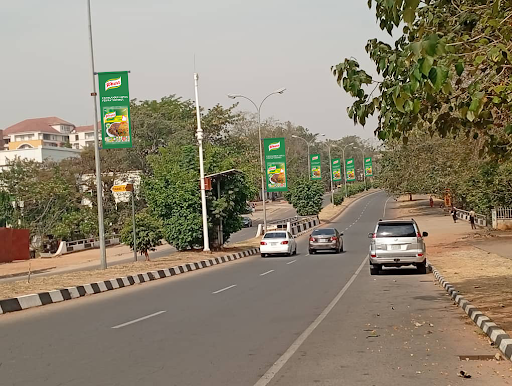
Lamppost advertising in Nigeria is one of the most cost-effective ways for brands to gain visibility without the high cost of billboards.
Not every brand can open with a billboard on Aba Road or the Lekki-Epe Expressway. Some are launching a new business. Some are testing a market for the first time. Some have a budget that works for outdoor advertising, but not at billboard scale.
This is where lamppost advertising comes in.
Lamppost banners are one of the most overlooked formats in Nigerian outdoor advertising, not because they are ineffective, but because they are misunderstood.
Brands either dismiss them as a small-budget compromise or deploy them without a clear strategy and then conclude they do not work.
This article is a practical buyer’s guide to lamppost advertising in Nigeria. You will learn exactly how it works, what it costs in different cities, when it makes more sense than a billboard, and how to plan a campaign that delivers real results rather than just filling lamp poles with a logo.
What Is Lamppost Advertising in Nigeria?

Lamppost advertising is a street-level outdoor advertising format that uses branded banners mounted on public street lighting poles along roads, commercial corridors, and event routes.
The banners are typically printed on durable PVC or vinyl material and attached to the lamp post structure using bracket arms or wraparound mounts.
Unlike a billboard, which commands attention from a distance through sheer size, a lamppost banner works through proximity and repetition.
A single banner seen once has a limited impact. But 30 banners on consecutive poles along a 400-metre stretch of road means every driver and pedestrian sees your message multiple times before they clear the corridor.
That repetition is the core mechanism of lamppost advertising. It is not about making a single big impression. It is about the frequency on a defined route.
Standard Lamppost Banner Dimensions in Nigeria
Lamppost banners in Nigeria typically come in two common formats: a single-sided banner that faces one direction of traffic only, and a double-sided banner that wraps around the pole and is readable from both directions.
Standard dimensions typically run between 60cm and 90cm wide by 150cm to 200cm tall, though vendors use different specifications depending on the pole structure and the road authority requirements.
Double-sided banners cost more per unit but provide visibility in both directions of traffic, significantly increasing their value on two-way roads and roundabout approaches where traffic flows from multiple directions.
Why Lamppost Advertising in Nigeria Is an Affordable Alternative to Billboards

Lower Entry Cost
A prime static billboard on Aba Road in Port Harcourt starts at around N300,000 per month in rental alone. A lamppost campaign of 20 to 30 banners on a comparable commercial road in Port Harcourt can be achieved for significantly less total investment. For brands comparing these costs, the cost of billboard advertising in Port Harcourt covers the full billboard pricing framework for the city.
This cost differential makes lamppost advertising the natural starting point for SMEs, local businesses, and brands testing a new market before committing to full billboard spend.
Route Ownership Without Billboard Competition
A single billboard competes visually with every other billboard, shop sign, and advertisement in its immediate environment. A brand that books 30 consecutive lamppost poles on a road achieves something different. It dominates a defined corridor. For the duration of the commute along that stretch, the brand is the only message repeating.
This corridor ownership effect is something a single billboard cannot replicate, regardless of its size or prominence. It is the unique advantage of the lamppost format.
Flexibility for Short Campaigns
Most billboard vendors require a minimum booking of one month. Lamppost campaigns can be structured around shorter, more targeted windows.
Event promotion, product launches with a specific go-live date, political campaigns tied to an election calendar, and seasonal offers tied to specific periods all benefit from the flexibility that lamppost advertising timelines can accommodate.
Street-Level Visibility to Pedestrians
Billboards are designed for visibility from a distance. Lamppost banners operate at the eye level of pedestrians, hawkers, and riders in slow-moving traffic.
In Nigerian cities where pedestrian commercial activity is significant, this street-level presence has real value that elevated billboard formats cannot deliver. This is particularly relevant in dense commercial corridors like Oshodi in Lagos, Ogbete Market in Enugu, or Wuse Market in Abuja.
For the full strategic context of how lamppost ads fit into a wider outdoor campaign, see the guide on the role of lamppost ads in billboard advertising.
How Much Does Lamppost Advertising Cost in Nigeria?
Lamppost advertising is priced per pole per month. The cost varies significantly by city, road quality, and the commercial intensity of the corridor. A detailed breakdown of lamppost advertising costs in Lagos covers the Lagos market specifically. Here is how pricing breaks down across major Nigerian cities.
| City | Secondary Roads (per pole/month) | Prime Commercial Roads (per pole/month) |
| Lagos | 70,000 to 100,000 | 100,000 to 200,000 |
| Abuja (static) | 100,000 to 200,000 | 100,000 to 200,000 |
| Abuja (Digital) | 600,000 to 700,000 | 600,000 to 700,000 |
| Port Harcourt | 70,000 to 100,000 | 12,000 to 30,000 |
| Ibadan | 70,000 to 100,000 | 100,000 to 200,000 |
| Enugu | 70,000 to 100,000 | 100,000 to 200,000 |
| Kano | 70,000 to 100,000 | 100,000 to 200,000 |
Banner printing and installation are charged separately by most lamppost vendors. Printing typically ranges from N42,000 to N80,000 per banner, depending on the material specification and quantity.
Installation and removal at the end of the campaign are usually bundled together and range from N80,000, depending on the city and the pole access requirements.
For a campaign of 30 poles on a prime commercial road in Lagos, the total first-month cost, including rental, printing, and installation, would typically fall between N900,000 and N2,000,000, depending on exact location and vendor.
The equivalent spend on a single prime roadside billboard in Lagos might buy only a secondary road placement, which gives some indication of the reach advantage lamppost advertising delivers per naira at this budget level.
When to Choose Lamppost Advertising in Nigeria Over a Billboard
Lamppost and billboard advertising are not in competition. They serve different purposes. But there are specific situations where lamppost advertising is genuinely the stronger choice, not just the cheaper one.
You Want to Dominate a Specific Corridor
If your goal is to own a particular road or commercial zone in the audience’s mind, 30 lamppost poles on that road will achieve it more completely than a single billboard at one end.
Real estate developers announcing a new estate on a specific road, retail businesses promoting a nearby store opening, and telecoms brands announcing a new service on a particular residential corridor all benefit from corridor ownership that lamppost advertising delivers.
Your Campaign Has a Short, Defined Window
A four-week product launch, a two-week event promotion, or a ten-day political campaign burst all suit the lamppost format better than a billboard booking. The shorter installation time, lower cost per campaign, and route-specific focus make lamppost advertising a more efficient tool for time-boxed objectives.
Your Budget Is Below the Billboard Threshold
If your total outdoor advertising budget for a city falls below N500,000, lamppost advertising is likely to deliver better coverage and frequency than a single secondary road billboard at the same price. For brands building their first outdoor advertising campaign, the guide to billboard advertising for small businesses covers how to approach OOH on a limited budget.
You Are Reinforcing a Larger Billboard Campaign
This is one of the strongest use cases for lamppost advertising. A brand running a billboard on a key arterial road can use lamppost poles along feeder roads leading to that billboard to build pre-awareness and frequency.
By the time the audience reaches the main billboard, they have already seen the message three to five times on the approach. This dramatically improves recall and makes the main billboard placement more effective.
You Are Promoting in a Pedestrian-Heavy Zone
Markets, university campuses, hospital approach roads, shopping corridors, and event venues generate significant pedestrian traffic that billboard formats elevated high above street level simply do not reach effectively.
Lamppost banners at pedestrian height in these zones communicate directly with the foot traffic that matters most for retail, healthcare, hospitality, and events campaigns.
How to Plan a Lamppost Advertising Campaign That Works

Define Your Route Before You Book Poles
The single most common mistake brands make with lamppost advertising is choosing poles randomly across a wide area rather than dominating a defined corridor.
Scattered poles across unrelated roads create low frequency on every road and no corridor ownership on any of them. Define one or two specific roads and book enough poles on each to create genuine repetition.
A minimum of 15 to 20 consecutive poles on a single road is the threshold at which frequency begins to build meaningful recall.
Match the Route to Your Audience
A bank targeting working professionals should book poles on the roads that those professionals use for their daily commute, not the roads nearest to the bank branch.
A school should book poles on the roads that parents use during school run hours. A pharmacy should concentrate poles along the approach roads to residential estates and health facility clusters. The route is a targeting decision, not just a logistics one.
Design for Three Seconds
Lamppost banners are small and seen at close range in moving traffic. The design principles are the same as for any large-format outdoor: one message, one visual, maximum contrast, minimal text.
A banner that tries to communicate pricing, a product image, a headline, a tagline, and a phone number will fail. Pick one thing. The billboard advertising design best practices guide applies equally to lamppost banners despite the difference in scale.
Confirm Regulatory Compliance Before Installation
Lamppost advertising requires approval from the relevant state authority before installation.
In Lagos, LASAA governs lamppost structures. In Abuja, the FCT Minister’s office oversees signage on public infrastructure. Lamppost banners installed without the correct permits can be removed by state enforcement teams, wasting the entire production and installation spend.
ARCON creative vetting is also required for lamppost advertising campaigns, just as it is for billboards. Confirm that your vendor handles both before committing.
Book for the Right Duration
Lamppost campaigns need a minimum of three to four weeks to build meaningful frequency with a regular commuter audience.
A two-week campaign on a busy road will be seen by most of the target audience only two to four times, which is below the threshold at which outdoor advertising reliably builds brand recall.
Four to six weeks is the minimum for campaigns focused on awareness. For product launches with a specific date, coordinate the lamppost campaign to peak in the week before and the week of the launch date.
Frequently Asked Questions About Lamppost Advertising in Nigeria
Do lamppost banners require ARCON approval in Nigeria?
Yes. All outdoor advertising in Nigeria, including lamppost banners, requires ARCON (Advertising Regulatory Council of Nigeria) creative vetting before installation.
How many lamp post poles do I need for an effective campaign?
The minimum for meaningful corridor frequency is 15 to 20 consecutive poles on a single road. Below this threshold, the repetition effect that makes lamppost advertising work is significantly diminished.
How long does the lamppost banner installation take?
Once permits are confirmed and banners are printed, installation typically takes two to three working days for a standard 20 to 30-pole campaign. Larger campaigns across multiple roads may take five to seven working days.
Can I use a lamppost for a political campaign in Nigeria?
Yes. Lamppost advertising is one of the most commonly used formats for political campaigns in Nigeria, particularly for ward-level and local government campaigns where corridor visibility in specific communities matters more than city-wide billboard reach.
Are lamppost banners visible at night?
Standard lamppost banners are not illuminated and have limited visibility after dark. However, because lamppost banners are mounted on street lighting poles, the existing streetlight itself provides some indirect illumination in areas with functioning street lighting.
Want to Plan a Lamppost Advertising Campaign in Nigeria?
If you’re planning a lamppost advertising campaign in Nigeria, working with the right locations and strategy makes all the difference.
Oxbillboards gives you access to verified outdoor advertising placements across Nigeria, including lamppost advertising routes, static billboards, digital LED screens, and gantry positions across Lagos, Abuja, Port Harcourt, Ibadan, and other major cities. Talk to the Oxbillboards team about available routes and pricing for your next campaign.
READ MORE
The Role of Lamppost Ads in Billboard Advertising
Cost of Lamppost Advertising in Lagos (2026 Guide)
What Are the Costs of Billboard Advertising in Nigeria?
7 Budget Allocation Strategies for Billboard Advertising in Nigeria
