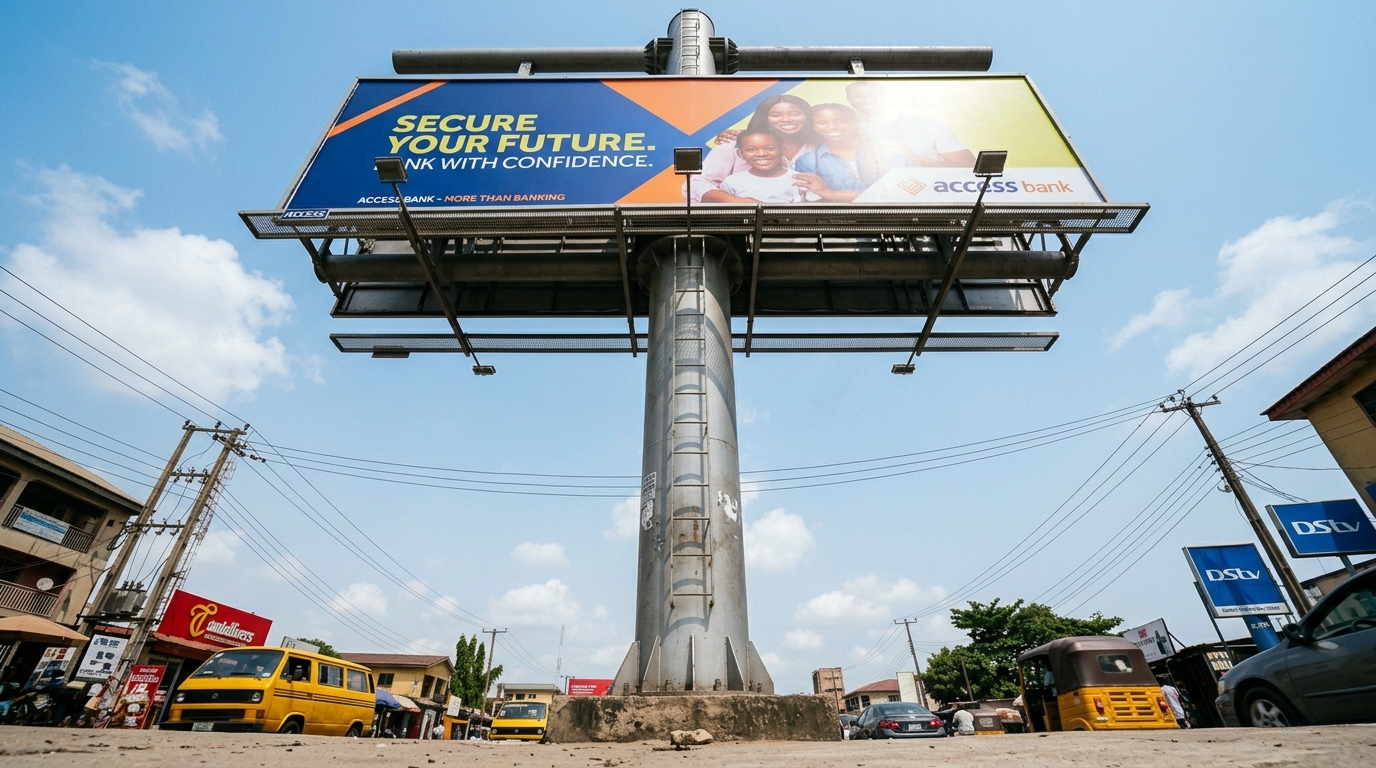

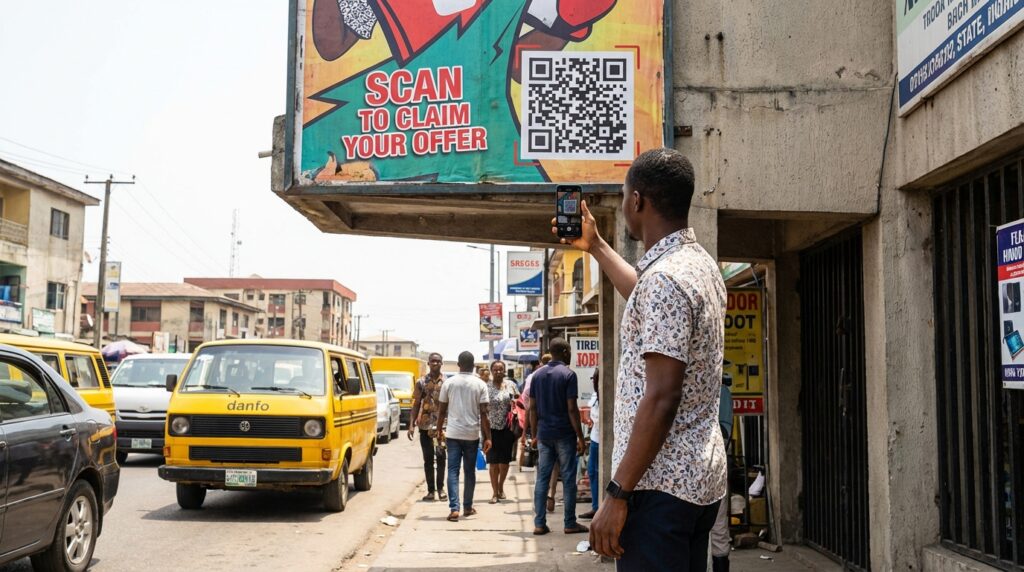
A brand spends over a million naira on a billboard, adds a tiny QR code in the bottom corner as an afterthought, and wonders why nobody scanned it.
The code was the size of a postage stamp. It linked to a desktop website that barely loaded on mobile. And the billboard was on a highway where nobody could stop to scan anything.
QR codes on billboards can work very well in Nigeria. But only when they are used with the same deliberate thinking that goes into every other element of the campaign. This guide covers exactly how to do that.
Why QR Codes and Billboards Are a Stronger Combination Than Most Nigerian Brands Realise
Nigeria has over 150 million active mobile internet users. Smartphone penetration continues to grow rapidly across every age group and income tier. And the native QR code scanner built into most modern smartphone cameras means the friction of scanning a code has dropped significantly compared to even three years ago.
When a billboard carries a QR code that is well-placed, well-sized, and links to something genuinely useful, it becomes more than an awareness tool. It becomes a measurable, interactive touchpoint that connects outdoor reach to digital action.
For Nigerian brands that struggle to prove OOH return on investment, a QR code provides something rare in outdoor advertising: a direct, trackable link between the billboard and the audience behaviour it generates.
Every scan is a data point. Every data point is a piece of accountability.
The combination works. The execution is where most Nigerian campaigns fall short.
When QR Codes Work on Billboards and When They Do Not
Before designing a QR code into your billboard artwork, be honest about whether the placement context actually supports scanning behaviour.
QR codes work well on billboards when:
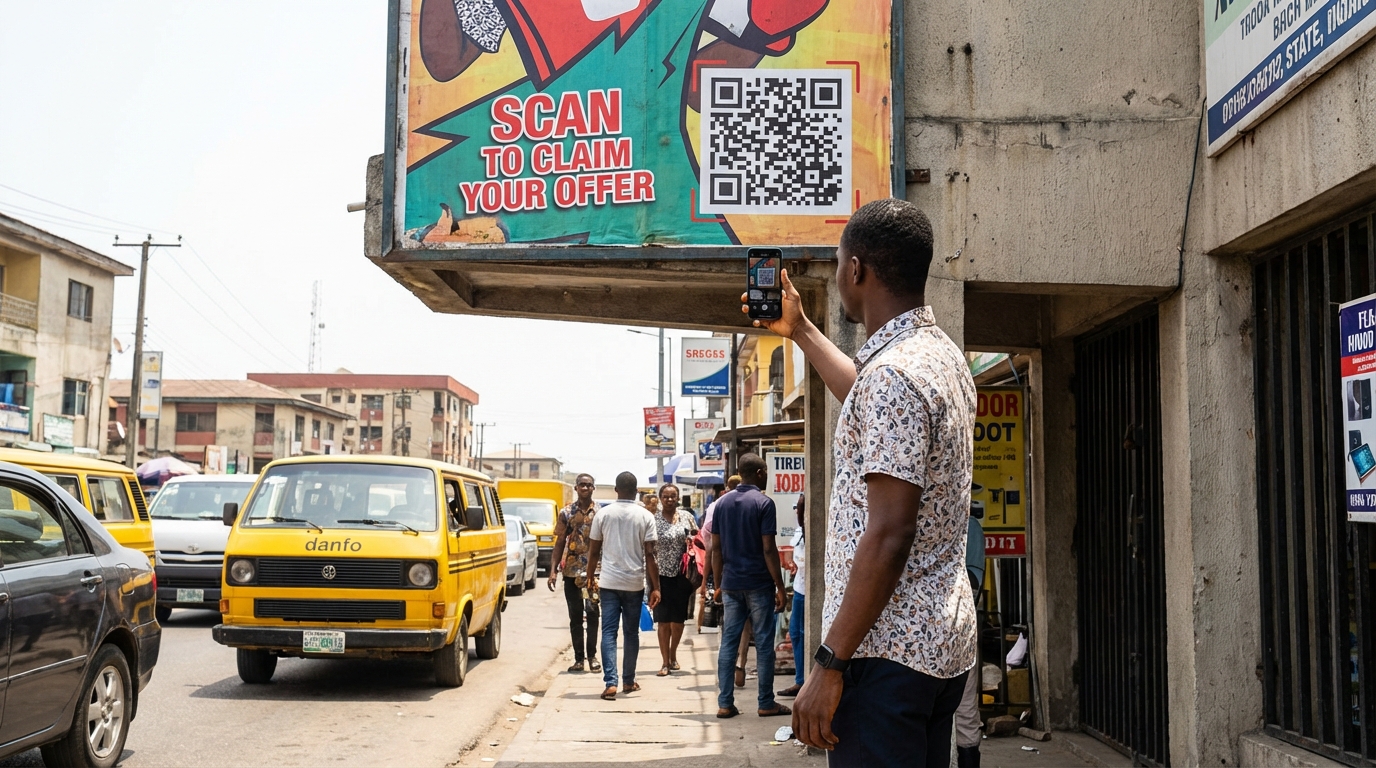
- The board is in a location where the audience can stop or slow down long enough to scan, such as bus stops, pedestrian zones, traffic-prone junctions, car parks, or slow-moving commercial roads
- The target audience is smartphone-comfortable, typically urban, between 18 and 45, with regular mobile internet access
- The campaign has a specific call to action that benefits from a direct digital link, such as a product purchase, event registration, app download, or special offer
- The creative has enough space to feature the QR code at a scannable size without cluttering the main message
QR codes are unlikely to generate meaningful scans when:
- The board is on a high-speed expressway where drivers are moving at 80 to 100 km/h with no opportunity to stop
- The board is mounted very high on a unipole, where the code is too far from eye level to scan reliably
- The board is in an area with consistently poor mobile data connectivity
- The campaign message is purely awareness-based with no specific action to drive
Choosing the wrong placement context is the single biggest reason QR codes fail on Nigerian billboards. The code itself is rarely the problem.
How to Use QR Codes on Billboards in Nigeria: 7 Practical Rules
Getting a QR code to work on a billboard is not complicated. But it requires deliberate decisions at every stage of the creative and production process.
These seven rules address the most common failures in Nigerian billboard QR code execution.
Rule 1: Make the QR Code Large Enough to Scan from a Distance
The minimum size for a scannable QR code on a billboard depends on the distance from which your audience will be scanning it.
A general benchmark used in outdoor advertising is that a QR code should be at least 1.5 cm in size for every 10 cm of scanning distance.
For a bus shelter or street furniture board where someone might scan from 1 to 2 metres away, a code of 15 to 30 cm on the printed board is workable.
For a standard 48-sheet billboard where scanning might happen from 3 to 5 metres, the code should be significantly larger: a minimum of 40 to 60 cm on the printed board.
When in doubt, make the code bigger. A QR code that is too large does no harm. One that is too small generates zero scans.
Rule 2: Place the Board Where Scanning Is Physically Possible

This rule is about location selection, not just design. Before committing to a QR code as part of your billboard campaign, confirm that the specific board you are booking is in a location where your audience can realistically stop and scan.
The strongest locations for QR-enabled billboards in Nigeria include:
- Bus stops and BRT shelters along Lagos routes
- Billboard faces visible from slow-moving traffic at known congestion points
- Boards adjacent to commercial areas where pedestrian footfall is high
- Car park entrances and exits near shopping centres or markets
- Street-level boards in pedestrianised zones of city centres
Rule 3: Give People a Clear Reason to Scan
A QR code alone is not a call to action. The billboard must tell the audience what they will get by scanning and why it is worth the effort.
Strong scan incentives for Nigerian audiences include:
- “Scan to get 20% off your first order”
- “Scan to register for early access”
- “Scan to watch the full story”
- “Scan to find our nearest location”
- “Scan to apply now”
Weak or vague scan prompts, such as “Scan to learn more” or “Scan to visit our website”, give the audience no compelling reason to act. The value of scanning must be obvious, immediate, and specific.
Rule 4: Link to a Mobile-Optimised Destination
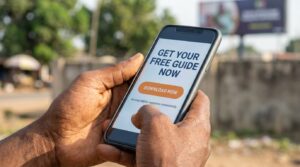
This is where most Nigerian billboard QR campaigns fail. The code is scanned. The audience lands on a desktop website that loads slowly on mobile, requires pinching and zooming to navigate, and has no clear next step. The scan was wasted.
Every QR code on a billboard must link to a destination built specifically for mobile viewing. That means:
- Fast loading on standard Nigerian mobile data speeds, not just WiFi
- A single, clear call to action visible above the fold without scrolling
- No pop-ups, no interstitials, no long registration forms as the first thing the user sees
- A design that works on a small screen in natural daylight, where glare can affect visibility
If your current website is not mobile-optimised, build a dedicated landing page specifically for the billboard campaign. The investment is small relative to the media cost of the board.
Rule 5: Use a Trackable QR Code
A static QR code that links directly to a URL tells you nothing about how many people scanned it. A dynamic, trackable QR code generated through a platform such as QR Code Generator, Bitly, or Beaconstac gives you scan data, including total scans, scan location, device type, and time of scan.
This data is what transforms a billboard QR code from a design element into a measurement tool.
It allows you to calculate a scan rate for the campaign, compare performance across multiple billboard locations, and provide concrete engagement data when reporting campaign results internally.
Always use a trackable QR code on a billboard. The setup takes five minutes and costs nothing on most platforms.
Rule 6: Keep the Rest of the Billboard Simple
A QR code is an addition to the billboard creative, not a replacement for a clear primary message. The most common mistake in QR-enabled billboard design is allowing the code and its supporting copy to compete with the headline and key visual for attention.
The QR code and its call-to-action text should occupy a defined, subordinate zone of the billboard layout, typically the lower right or lower left corner, at a size that is prominent enough to notice but does not dominate the overall visual hierarchy.
The headline still needs to be the first thing the audience reads. The visual still needs to communicate the brand and message instantly. The QR code invites the next step for those who want to go further. That is its role, not the leading role.
Rule 7: Test Before You Print
Print a scaled version of your billboard artwork and attempt to scan the QR code from the equivalent distance your audience will be scanning from on the road. Test on multiple smartphone models, including both high-end and mid-range devices, common in Nigeria.
If the code fails to scan reliably in this test, the problem needs to be fixed before the vinyl goes to production. Discovering a scanning failure after the board is mounted costs a full reprint and remount. Discovering it during testing costs nothing.
What Should Your Billboard QR Code Link To?
The destination your QR code links to should match the campaign objective precisely. Here are the most effective destination types for Nigerian billboard QR campaigns:
| Campaign Objective | Best QR Destination |
| Product purchase | Mobile-optimised product page or checkout |
| App download | App Store or Play Store listing |
| Lead generation | Short mobile form with one to three fields maximum |
| Event registration | Single-page event signup with date and CTA visible immediately |
| Store or branch finder | Google Maps location or branch locator tool |
| Content engagement | Short video, lookbook, or article optimised for mobile |
| Offer redemption | Voucher or discount code page with a clear expiry date |
Whatever the destination, ensure the link between what the billboard promises and what the landing page delivers is immediate and obvious. Any gap between the billboard message and the landing page experience creates drop-off.
How to Measure QR Code Performance on a Billboard

With a trackable QR code in place, you can monitor the following metrics throughout and after the campaign:
- Total scans: The overall number of times the code was scanned during the campaign period
- Daily scan volume: Which days generated the most scans, revealing peak engagement periods
- Scan-to-conversion rate: Of those who scanned, how many completed the desired action on the landing page
- Device breakdown: Whether scans came from iOS or Android devices, useful for future targeting decisions
- Geographic scan data: Available on some platforms, showing where scans were concentrated
Compare total scans against the estimated traffic count for the billboard location to calculate an approximate scan rate. Even a scan rate of 0.1 to 0.5% of total traffic represents thousands of direct digital engagements from a single outdoor placement.
What Most Nigerian Brands Get Wrong About Billboard QR Codes
Adding the code after the creative is finished: A QR code integrated into the original design concept performs better than one squeezed into a completed layout. Plan for it from the brief stage.
Using a static QR code with no tracking: Without scan data, the code is decoration. Always use a dynamic, trackable code.
Linking to a homepage instead of a campaign page: A homepage is designed for multiple audiences and multiple purposes. A billboard QR code should go to a single-purpose page designed for one audience doing one thing.
Making the code too small to save space: Creative directors sometimes reduce the QR code size to preserve the visual layout. The result is a code that cannot be scanned. A slightly less elegant layout that generates scans is always preferable to a beautiful layout that generates none.
Not renewing the QR code link mid-campaign: Dynamic QR codes allow you to change the destination URL without reprinting the board. If your offer changes, your event date shifts, or your landing page is rebuilt mid-campaign, update the destination. The code on the board stays the same.
Frequently Asked Questions
Do QR codes actually get scanned on Nigerian billboards?
Yes, in the right context.
How big should a QR code be on a standard Nigerian 48-sheet billboard?
For a standard 48-sheet billboard where scanning happens from approximately 3 to 5 metres, the QR code should be at least 40 to 60 cm on the printed vinyl.
Should I use a free QR code generator for my billboard campaign? Free generators are acceptable for basic use, but platforms that offer dynamic codes with scan tracking are strongly recommended for billboard campaigns. Bitly, QR Code Generator Pro, and Beaconstac all offer trackable QR codes with analytics dashboards.
What colour should a billboard QR code be?
Black on white is the most reliably scannable combination. Coloured QR codes can work, but are less reliably scanned across all smartphone models.
Conclusion
A QR code on a billboard is not a design decision. It is a strategy decision. When the location supports scanning, the code is properly sized, the call to action is compelling, and the destination is built for mobile, a billboard QR code bridges outdoor reach and digital accountability in a way that few other OOH tools can match.
Used correctly, it turns a static board into a measurable campaign asset. Used carelessly, it becomes a postage stamp in the corner of an expensive piece of vinyl that nobody scans, and nobody remembers.
The difference is intention. Plan the QR code from the brief. Choose the right location. Build the right destination. Track every scan. And use what you learn to make the next campaign smarter.
Oxbillboards helps brands in Nigeria find and verify the right billboard locations for exactly this kind of integrated, accountable outdoor campaign, giving you the location intelligence to choose placements where QR codes will actually work, not just exist.