
Walk into any supermarket in Nigeria. Look at the shelves. Now think about the brands you reached for first without reading the label, checking the price, or comparing alternatives.
You already knew those brands. Not because you researched them. Because they had been showing up in your life, on roads, on highways, at bus stops.
That invisible familiarity is what FMCG billboard advertising builds. And in Nigeria’s consumer goods market, it is one of the most powerful competitive advantages a brand can hold.
This article breaks down exactly why billboard advertising works for FMCG brands in Nigeria, how to time your campaigns for maximum impact, how to align your outdoor presence with your distribution footprint, and what sustained OOH investment looks like in practice.
By the end, you will understand why the biggest consumer goods brands in Nigeria never stop advertising outdoors, and why the ones that do lose ground faster than they expect.
Why FMCG Brands Dominate Billboard Advertising in Nigeria
Retail and FMCG advertisers remained the top outdoor spenders in Nigeria in 2024, commanding a 28% slice of the OOH advertising market, leveraging proximity messaging near hypermarkets and open-air markets.
That statistic is not an accident. FMCG brands spend more on outdoor advertising in Nigeria than any other category because outdoor advertising delivers exactly what FMCG marketing requires: mass reach, repeated exposure, and physical proximity to the point of purchase.
FMCG products: beverages, snacks, household cleaners, personal care products, food staples, are bought frequently, often impulsively, and rarely after deep research.
The consumer who picks up a bottle of Malt drink or a bar of soap at a neighbourhood shop is not making a considered decision. They are defaulting to whichever brand feels most familiar.
Billboard advertising builds that familiarity at scale. It ensures your brand is the one that comes to mind when the hand reaches for the shelf.
The Three Pillars of FMCG Billboard Advertising in Nigeria
1. Sustained Presence Over Burst Campaigns
The single most important principle of FMCG outdoor advertising in Nigeria is consistency.
A one-month burst campaign will create a temporary spike in brand recall that fades within weeks. A six-month sustained presence begins to feel like part of the landscape, and that is exactly the position every FMCG brand wants to occupy in the Nigerian consumer’s mind.
With 62% of Nigerians projected to live in poverty and real household spending having contracted in 2025, affordability messaging moves from tactical promotion to strategic imperative for FMCG brands.
In this environment, consistent visibility becomes even more critical. Consumers with constrained budgets default to brands they trust, and trust is built through familiarity, which is built through repeated exposure over time.
This is why the biggest FMCG players in Nigeria, Nestlé, Unilever, PZ Cussons, Cadbury, and Guinness, do not treat billboard advertising as a campaign activity. They treat it as a permanent line in their media budget.
Their brand presence on Nigerian roads is not seasonal. It is continuous. And that continuity is a significant barrier to entry for smaller competitors trying to challenge their shelf dominance.
For FMCG brands without enterprise-level budgets, the strategy is the same, just applied more selectively.
Choose fewer locations, maintain them consistently, and resist the temptation to run short bursts across many sites.
2. Distribution-Area Alignment
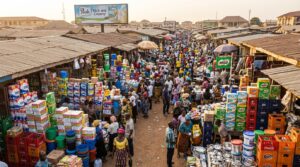
One of the most common and costly mistakes FMCG brands make with outdoor advertising in Nigeria is placing billboards in markets where their products are not yet available.
A consumer sees your brand on a Lagos highway billboard, looks for it at their local shop, and cannot find it. That disconnect does not just fail to convert; it actively damages brand perception. It makes the brand look aspirational rather than accessible.
Effective FMCG billboard advertising in Nigeria follows the distribution map. Billboards should be placed in cities, roads, and neighbourhoods where your product is already on shelves and available for purchase.
The outdoor presence reinforces the retail availability. Together, they create a purchase environment where seeing the billboard and buying the product can happen within the same 24 hours.
If your distribution is currently concentrated in Lagos, your billboard investment should be concentrated in Lagos. As distribution expands to Abuja, Port Harcourt, Onitsha, and Kano, your outdoor presence should expand with it.
3. Seasonal Campaign Timing
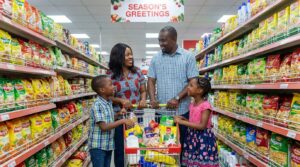
FMCG consumption in Nigeria is heavily seasonal. Spending spikes significantly around specific periods, and the brands that increase their outdoor visibility before and during these peaks capture a disproportionate share of wallet.
Key FMCG advertising periods in the Nigerian calendar:
Ramadan (March–April): Food, beverage, and household brands experience significant sales increases as household consumption patterns shift.
Outdoor campaigns targeting high-Muslim-population routes in Lagos, Kano, Kaduna, and Abuja during this period deliver strong reach against high-spending households.
Back-to-School (August–September and January): Cereal brands, juice brands, snack companies, and personal care products all see higher movement as school preparations drive purchasing.
Billboards near school routes, residential areas with high family concentration, and supermarket access roads perform well during these windows.
Yuletide (November–January): The highest FMCG spending period in the Nigerian calendar. Beverages, food staples, confectionery, and household goods all spike.
Billboard presence during this period, particularly in high-footfall retail corridors and routes to major markets, delivers maximum value.
Easter (March–April): Second major spending peak for beverages, food, and personal care. Southern Nigeria markets in particular show strong seasonal consumption patterns.
The brands that time their heaviest outdoor investment to coincide with these periods, while maintaining a baseline presence throughout the year, get the best return on their OOH budgets.
Billboard Creative Strategy for FMCG Brands
FMCG billboards in Nigeria need to communicate in three seconds or less. That is the average time a driver in motion has to register, read, and process an outdoor ad. Everything about the creative must serve that constraint.
- Show the product, not just the logo: FMCG products are bought by recognition. A clear, well-lit image of the product itself, the bottle, the pack, the bar, does more for purchase intent than abstract brand imagery.
The consumer needs to be able to connect the billboard to what they will find on the shelf.
- One message only: FMCG billboards that try to communicate multiple offers, multiple variants, or multiple benefits confuse the viewer and communicate nothing. Pick one message: the product, a seasonal promotion, a new variant launch, or a single benefit. Execute it boldly.
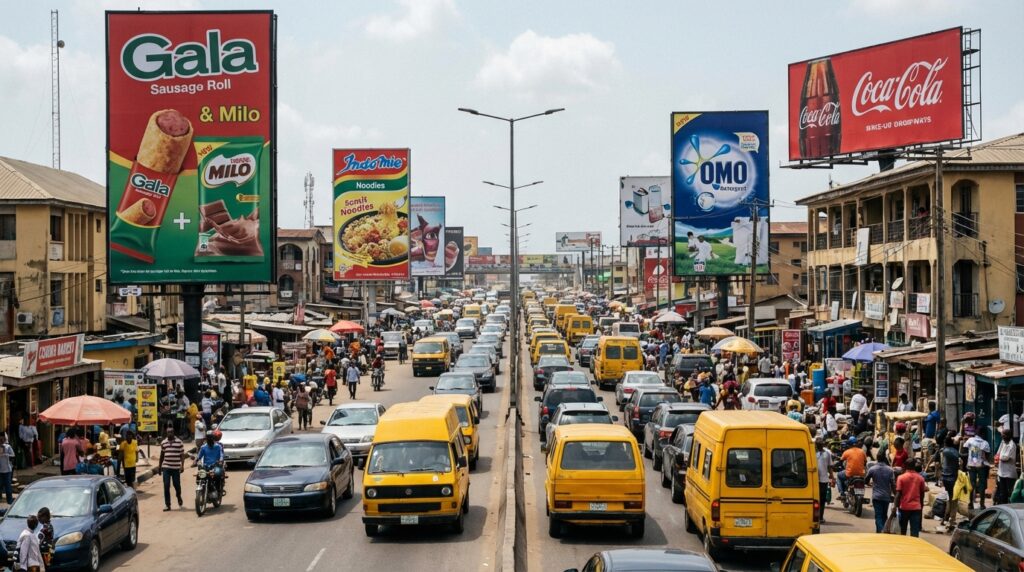
- Colour and contrast matter enormously: Many of Nigeria’s busiest roads are visually noisy, with other billboards, signage, traffic, and storefronts. Your billboard creative must stand out from that visual competition in an instant.
High contrast between the product image, the background, and the text ensures visibility at speed.
- Keep copy minimal: Five to seven words maximum for the headline. FMCG billboards are not the place for slogans, explanations, or product descriptions. If your message cannot be read in under three seconds, it will not be read at all.
Where to Place FMCG Billboards in Nigeria
Location selection for FMCG outdoor advertising should be driven by two questions: where do your target consumers travel regularly, and where are your products available for purchase?
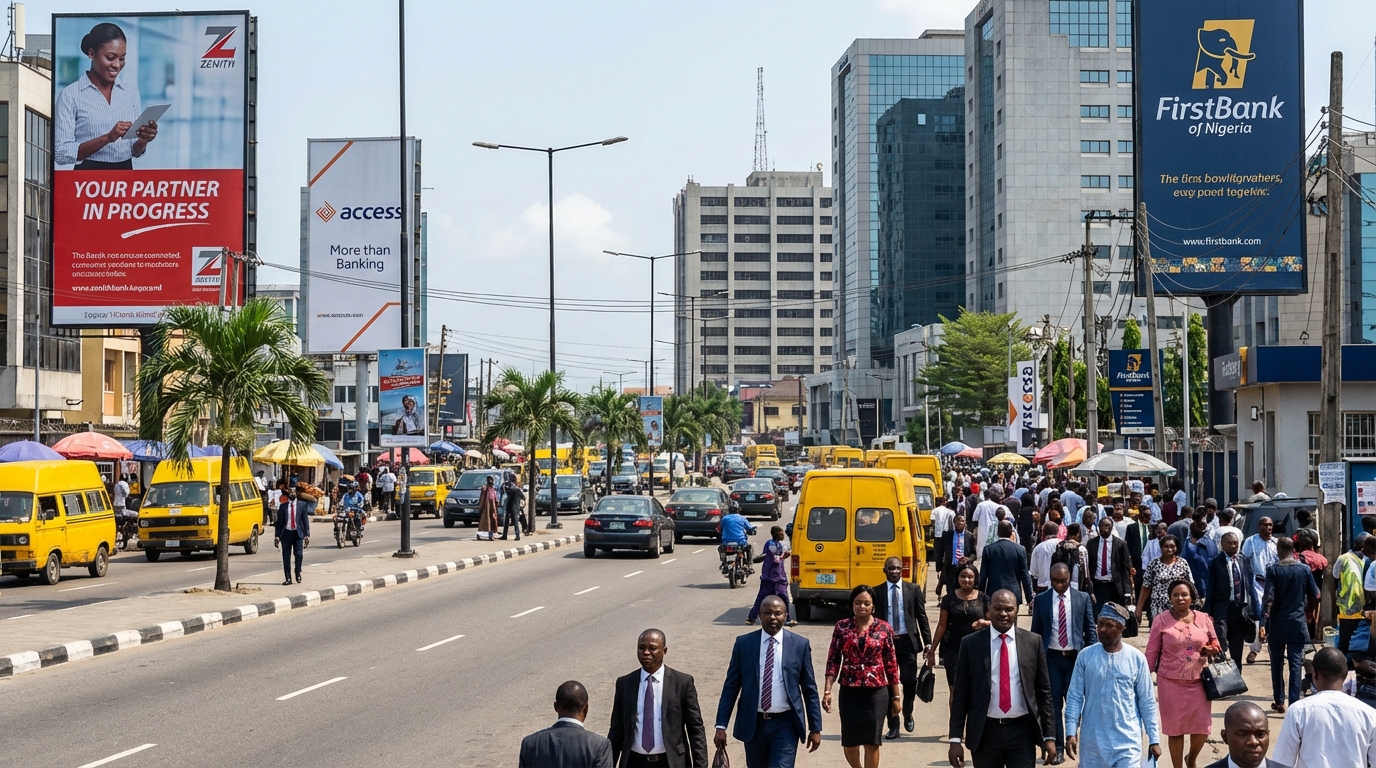
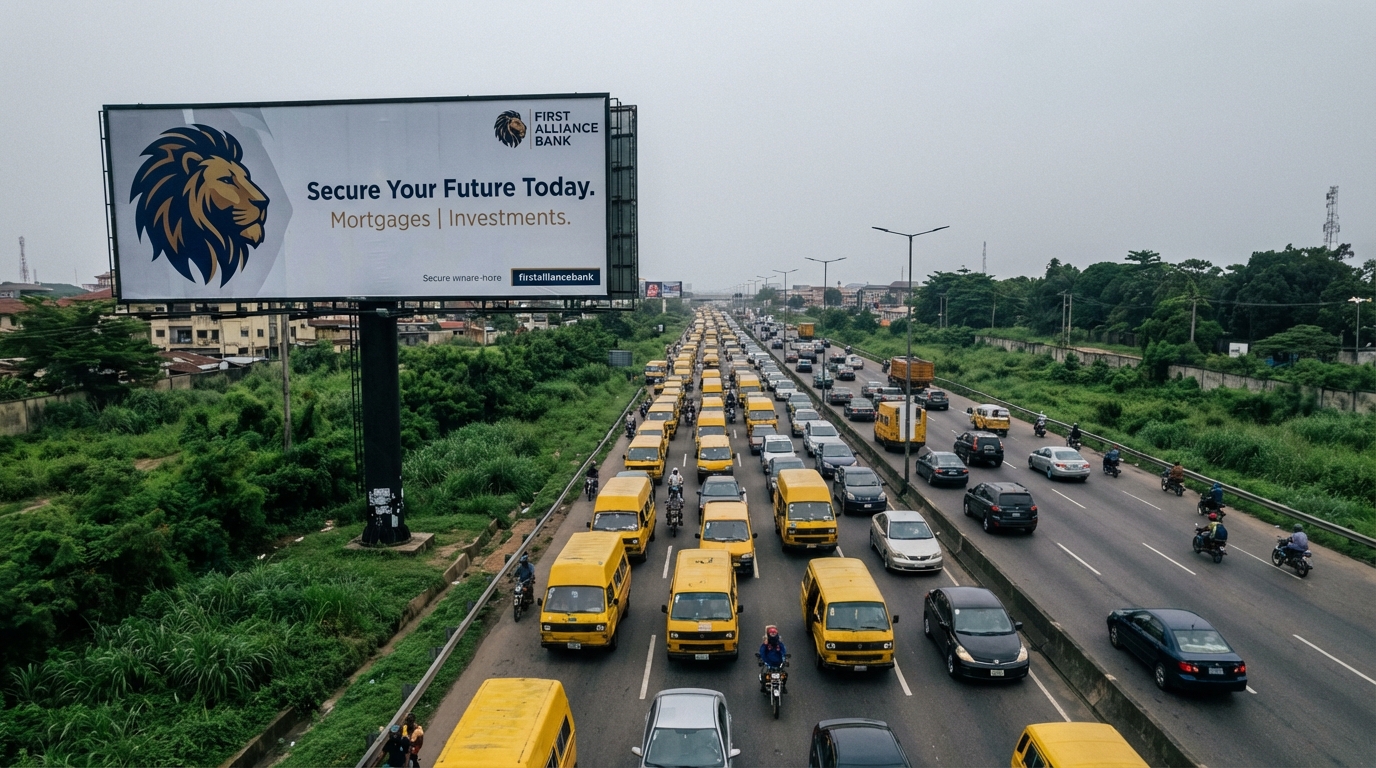
Expressways and major arterial roads
They deliver the highest reach for mass-market FMCG products targeting broad Nigerian audiences.
The Third Mainland Bridge, Lagos-Ibadan Expressway, Apapa-Oshodi Expressway, and Abuja-Keffi Road provide exposure to millions of Nigerians on a daily basis.
Proximity to open-air markets and retail clusters
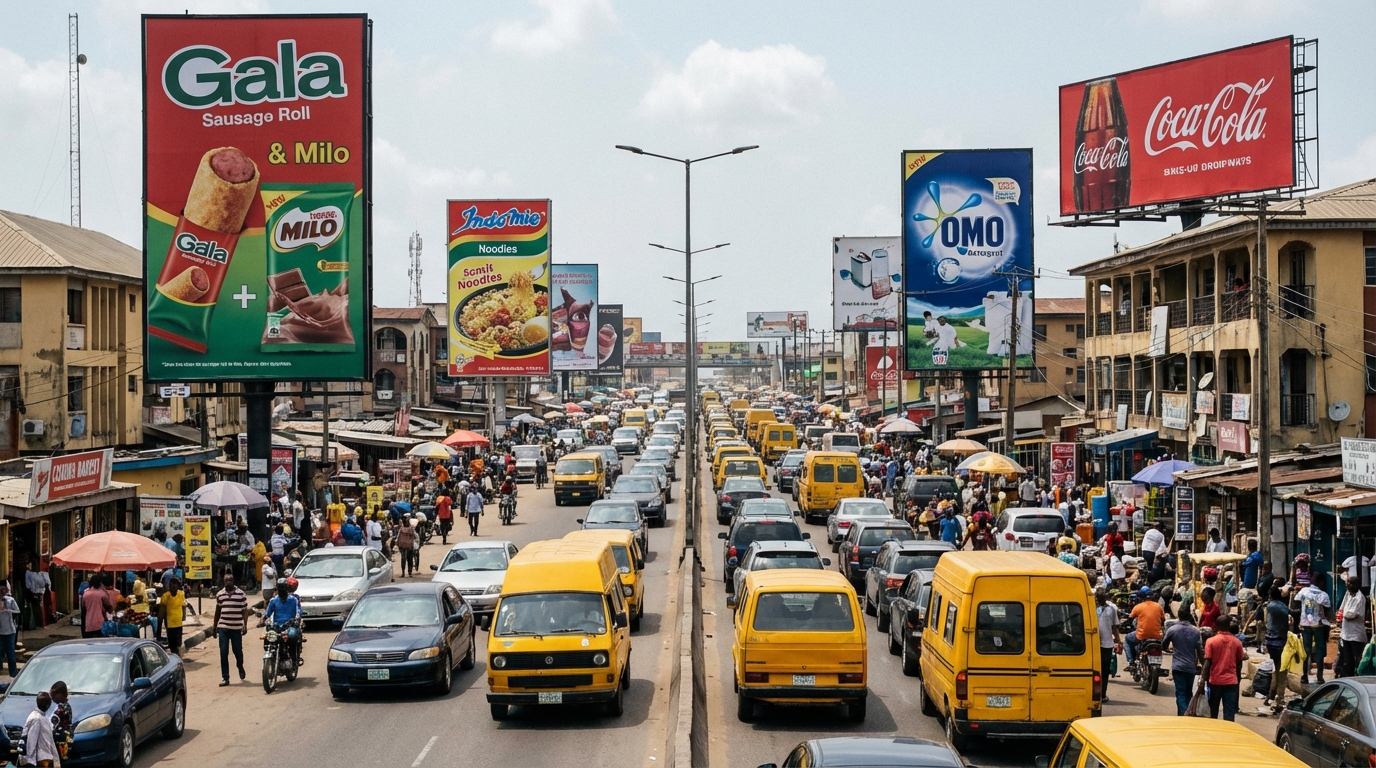
It is particularly powerful for FMCG brands. Nigerian FMCG advertisers leverage proximity messaging near hypermarkets and open-air markets as a core outdoor strategy.
A billboard on the road leading to Balogun Market in Lagos, Wuse Market in Abuja, or the main market in any major Nigerian city places your brand at the exact decision point where consumer goods purchasing happens.
Residential neighbourhood roads
High-density areas deliver repeated daily exposure to the same consumers who shop at nearby stores. For FMCG categories like food, personal care, and household products, this repeated neighbourhood-level exposure is extremely effective for building purchase habits.
What FMCG Billboard Advertising Costs in Nigeria
For FMCG brands budgeting outdoor campaigns in Nigeria, here is a realistic reference range:
Static billboards on secondary roads: ₦150,000 – ₦350,000 per month. High-traffic primary roads in Lagos: ₦350,000 – ₦1,000,000+ per month.
Digital billboards in prime urban locations: ₦1,000,000 – ₦3,000,000 per month. Production and printing: ₦50,000 – ₦300,000 per board, depending on size and materials.
For FMCG brands activating seasonal campaigns across multiple locations simultaneously, working with an outdoor advertising partner who can coordinate placements, production, and logistics across cities is significantly more efficient than managing individual sites separately.
Conclusion
The biggest FMCG brands in Nigeria do not stop advertising outdoors because they have already won the market. They do it because they understand that the moment they stop showing up on Nigerian roads, a competitor’s brand starts feeling more familiar. And in FMCG, familiarity is everything.
Whether you are managing a national consumer goods brand or building a regional FMCG business with genuine growth ambitions, sustained, strategically timed, distribution-aligned outdoor advertising is one of the most dependable tools in your media mix.
Ready to plan your FMCG outdoor campaign? Talk to the Oxgital team about billboard advertising
READ MORE:
How Outdoor Advertising Builds Trust for New Brands in Nigeria
Billboard Advertising for E-Commerce Brands in Nigeria
Billboard Advertising vs. Social Media Advertising in Nigeria: Which One Should You Choose?