

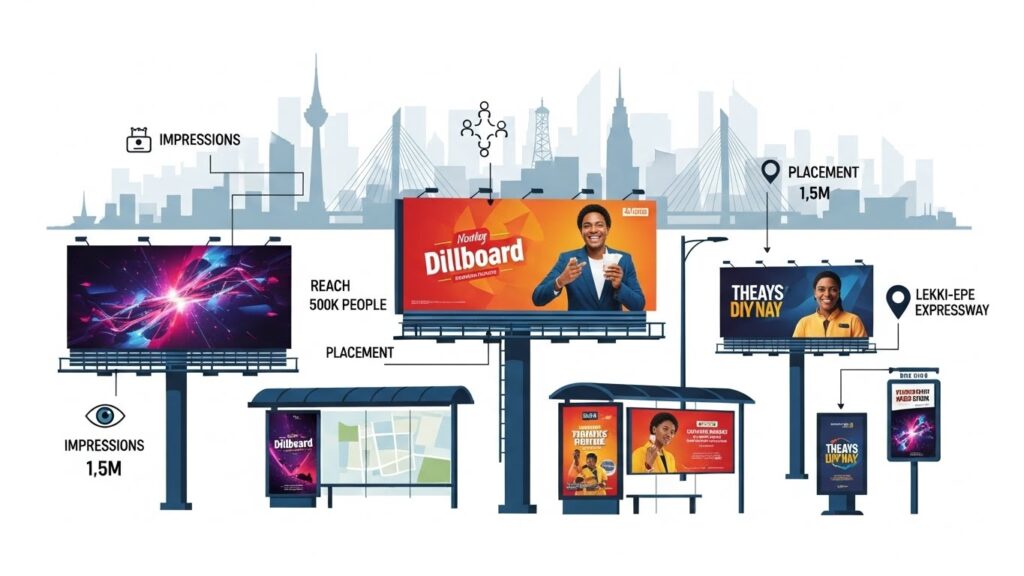
If you want to run billboard or OOH campaigns in Nigeria, you need more than locations and budgets.
You need to understand the language of the industry.
Because in Nigeria, billboard advertising terms are often:
- Used loosely
- Defined differently by agencies
- Influenced by local regulations and road realities
This glossary breaks down 30 essential OOH and billboard advertising terms, explained in plain Nigerian market context, not textbook theory.
Use it as a reference before planning, buying, or approving any outdoor campaign.
How This Glossary Is Structured
To make this easy to use, the terms are grouped into five categories:
- Core OOH and billboard formats
- Location and placement terminology
- Cost, pricing, and media buying terms
- Regulation and compliance language
- Performance and measurement concepts
Each term includes:
- A simple definition
- How it is used in Nigeria
- A practical example
Core OOH and Billboard Advertising Terms (1–10)
1. Out-of-Home (OOH) Advertising
Definition:
Any advertising that reaches people while they are outside their homes.
How it is used in Nigeria:
OOH includes billboards, LED screens, lamp poles, transit ads, and street furniture. Billboards make up the largest share of OOH spend.
Example:
A telecom brand advertising on billboards, BRT buses, and bus shelters is running an OOH campaign.
2. Billboard Advertising
Definition:
Large-format outdoor advertising structures are placed along roads, highways, and busy locations.
How it is used in Nigeria:
Billboards are the most trusted and visible form of OOH, especially in Lagos and Abuja.
Example:
A bank advertising on a unipole along Ikorodu Road is using billboard advertising.
3. Digital Out-of-Home (DOOH)
Definition:
OOH advertising is displayed on digital screens instead of printed materials.
How it is used in Nigeria:
DOOH is mostly LED billboards placed on major routes and premium locations.
Example:
A rotating ad on a large LED screen in Lekki Phase 1 is DOOH.
4. Static Billboard
Definition:
A billboard with a printed, non-moving creative.
How it is used in Nigeria:
Static billboards are common on highways and residential routes where long-term visibility matters.
Example:
A real estate company is advertising a new estate for six months on a printed board.
5. LED Billboard
Definition:
A billboard that uses LED screens to display digital content.
How it is used in Nigeria:
LED billboards dominate premium locations due to night visibility and multiple ad rotations.
Example:
A fintech brand running 10-second ads on a digital screen in Victoria Island.
6. Unipole Billboard
Definition:
A billboard mounted on a single tall pole.
How it is used in Nigeria:
Unipoles are common on expressways and high-traffic corridors.
Example:
A large-format billboard on the Lekki-Epe Expressway is mounted on one pole.
7. Gantry Billboard
Definition:
A billboard structure that spans across a road.
How it is used in Nigeria:
Gantry billboards are highly visible but heavily regulated due to safety concerns.
Example:
A billboard crossing an expressway near a toll gate.
8. Lamp Pole Advertising
Definition:
Smaller advertising panels mounted on street light poles.
How it is used in Nigeria:
Used for mass reach and directional messaging across multiple streets.
Example:
An event promotion was displayed on 100 lamp poles across Surulere.
9. Transit Advertising
Definition:
Advertising is placed on or inside public transport systems.
How it is used in Nigeria:
Includes buses, BRTs, terminals, and sometimes ferries.
Example:
A mobile app advertising on BRT buses in Lagos.
10. Street Furniture Advertising
Definition:
Advertising is placed on public utility structures.
How it is used in Nigeria:
Includes bus shelters, kiosks, and street signs.
Example:
Ads are displayed at bus stops in high-footfall areas.
Location and Placement Terms (11–17)
11. Prime Location
Definition:
A billboard location with high visibility and strategic positioning.
How it is used in Nigeria:
Prime locations are defined by traffic, sightlines, and brand environment, not just popularity.
Example:
A billboard positioned at a major junction with long traffic queues.
12. High-Traffic Route
Definition:
A road with heavy daily vehicle movement.
How it is used in Nigeria:
Traffic volume increases exposure, but congestion increases effectiveness.
Example:
The Third Mainland Bridge during weekday rush hours.
13. Dwell Time
Definition:
The amount of time people spend exposed to an ad.
How it is used in Nigeria:
Traffic congestion creates longer dwell time and better recall.
Example:
Ads on Oshodi routes benefit from long dwell times during gridlock.
14. Directional Billboard
Definition:
A billboard designed to guide audiences to a nearby location.
How it is used in Nigeria:
Common for malls, estates, schools, and event venues.
Example:
A billboard that says “500m ahead, turn right.”
15. Landmark Visibility
Definition:
Using popular landmarks to improve recognition and recall.
How it is used in Nigeria:
Addresses are often explained using landmarks instead of street names.
Example:
“Opposite Shoprite, Ikeja.”
16. Route Dominance
Definition:
Owning multiple billboard placements along one route.
How it is used in Nigeria:
Used by big brands to reinforce recall and block competitors.
Example:
A telecom brand is advertising on five consecutive billboards on one expressway.
17. Catchment Area
Definition:
The geographical area influenced by a billboard location.
How it is used in Nigeria:
Catchment areas are estimated using traffic flow and nearby neighborhoods.
Example:
A billboard in Alausa targets office workers and residents nearby.
Cost, Pricing, and Media Buying Terms (18–23)
18. Media Owner
Definition:
The company that owns the billboard structure.
How it is used in Nigeria:
Media owners control inventory and pricing.
Example:
A company that owns 50 unipoles across Lagos.
19. Media Buying
Definition:
The process of securing advertising placements.
How it is used in Nigeria:
Can be done directly with media owners or through agencies.
Example:
An agency negotiating placements for a national campaign.
20. Rate Card
Definition:
A document listing official billboard prices.
How it is used in Nigeria:
Rate cards are guidelines, not final prices.
Example:
Negotiated discounts during low-demand periods.
21. Production Cost
Definition:
The cost of printing, fabrication, and mounting.
How it is used in Nigeria:
Production is usually billed separately from media cost.
Example:
Printing and installing a flex face on a static billboard.
22. Campaign Duration
Definition:
The length of time an ad runs.
How it is used in Nigeria:
Most billboard campaigns run for three to twelve months.
Example:
A six-month awareness campaign.
23. Make-Good
Definition:
Compensation for lost exposure.
How it is used in Nigeria:
Offered when ads are removed or obstructed.
Example:
Extra weeks added after a temporary takedown.
Regulation and Compliance Terms (24–27)
24. LASAA
Definition:
Lagos State Signage and Advertisement Agency.
How it is used in Nigeria:
LASAA regulates all billboard advertising in Lagos.
Example:
Approval is required before mounting any billboard.
25. Billboard Permit
Definition:
Official authorization to display a billboard.
How it is used in Nigeria:
Permits are location-specific and time-bound.
Example:
Operating without a permit can lead to removal.
26. Approval Timeline
Definition:
The time required to secure regulatory approval.
How it is used in Nigeria:
Timelines vary by state and campaign complexity.
Example:
Delays are common during political seasons.
27. Illegal Structure
Definition:
A billboard was erected without proper approval.
How it is used in Nigeria:
Illegal structures are often dismantled without notice.
Example:
Unapproved roadside boards were removed during enforcement exercises.
Performance and Measurement Terms (28–30)
28. Impressions
Definition:
The estimated number of times an ad is seen.
How it is used in Nigeria:
Impressions are calculated using traffic estimates.
Example:
A busy junction generates deeper daily impressions.
29. Reach and Frequency
Definition:
Reach is how many people see the ad. Frequency is how often they see it.
How it is used in Nigeria:
High-frequency drives are recalled due to daily commuting patterns.
Example:
Seeing the same ad every weekday on your route to work.
30. Return on Investment (ROI)
Definition:
The value generated from an advertising spend.
How it is used in Nigeria:
ROI is measured through brand lift, foot traffic, and sales impact.
Example:
Increased inquiries after a billboard launch.
Commonly Misused OOH Terms in Nigeria
- “Premium location” does not always mean high-performing
- “Guaranteed traffic” does not guarantee conversions
- “Strategic location” must be backed by visibility and audience fit
Understanding the difference protects your budget.
How to Use This Glossary When Planning Campaigns
- Ask clearer questions
- Evaluate proposals objectively
- Avoid regulatory and pricing surprises
- Choose locations that match your goals
Final Thought
Billboard and OOH advertising in Nigeria rewards brands that understand the terrain, the rules, and the language.
This glossary gives you that foundation.
From here, the real advantage comes from applying these terms to locations, formats, and strategy with intention.