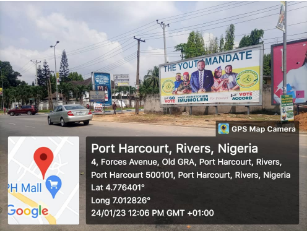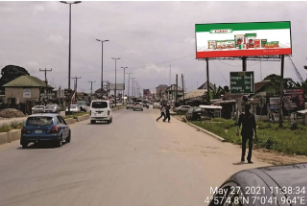


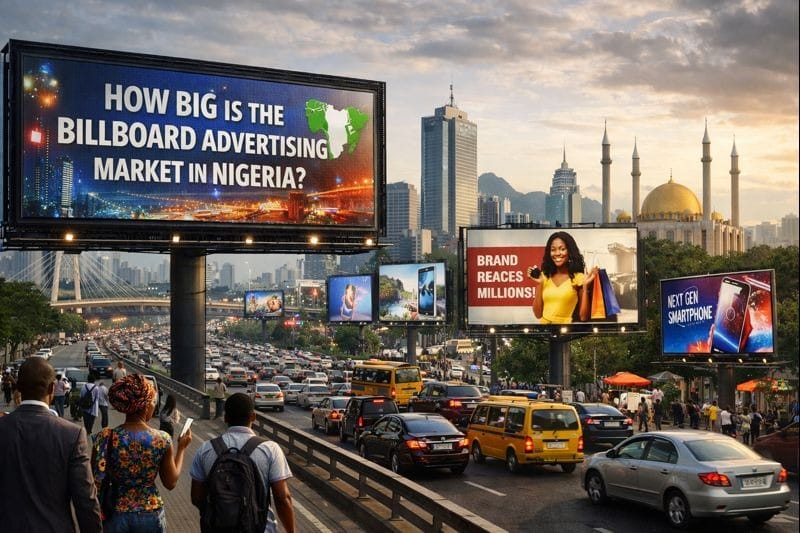
Billboard advertising in Nigeria operates at the intersection of media, infrastructure, urban mobility, and competitive brand strategy. It is not a decorative layer of marketing or a secondary awareness channel. It is a visibility system embedded into how Nigerian cities function daily.
Road networks, traffic congestion, commercial zoning, and population movement patterns determine where human attention accumulates. Billboards are positioned precisely at these attention choke points. They are not placed randomly. They are engineered into the physical flow of everyday life.
When brands invest in outdoor advertising in Nigeria, they are not merely purchasing ad space. They are purchasing territorial visibility, control of visual real estate inside the daily routes of millions of consumers. This physical integration with routine movement is what gives the Nigerian billboard market its scale, resilience, and strategic importance.
To understand how large and influential this market truly is, it is not enough to look at surface-level revenue figures. The real picture emerges when we examine the economic forces, structural constraints, urban behavior, regulatory frameworks, and technological shifts that continue to drive expansion.
Nigeria’s Billboard Market Within the National Advertising Economy
Nigeria’s broader advertising industry is valued at over ₦605.2 billion, spanning television, radio, print, digital, and out-of-home (OOH) media. Within this ecosystem, billboard advertising plays a structurally distinct role.
Unlike digital advertising, which relies on software platforms and data access, billboard advertising requires physical capital. It demands land agreements, steel structures, installation engineering, power supply, regulatory approval, and ongoing maintenance. This makes outdoor advertising one of the most infrastructure-intensive segments of Nigeria’s media industry.
The Nigerian out-of-home advertising market is projected to reach USD 250–309 million between 2025 and 2030, growing at an estimated 14.89 percent compound annual growth rate (CAGR). This is not short-term or speculative growth. It reflects sustained demand from brands that continue to prioritize physical visibility despite the rise of digital channels.
Television delivers mass reach. Digital platforms deliver targeting and performance metrics. Billboards deliver spatial dominance.
In highly competitive sectors, spatial dominance becomes a strategic asset. Brands that control major highways, bridges, and intersections shape consumer perception at a subconscious level. Consistent physical presence signals legitimacy, scale, and permanence—qualities that are difficult to replicate online.
Why Billboard Advertising Remains Highly Effective in Nigeria
Physical Integration With Daily Life
Nigerian urban life is fundamentally road-centered. Unlike cities built around walkable downtown cores, Nigerian cities rely heavily on road transport for commuting, logistics, commerce, and social movement.
Millions of people spend hours daily navigating highways, bridges, expressways, and arterial roads. Billboard placements along these routes are not interruptions; they are part of the visual environment.
This creates a level of exposure frequency that few media channels can match.
Traffic Congestion as an Exposure Multiplier
While traffic congestion is economically inefficient, it functions as an advertising multiplier.
Long dwell times increase the number of seconds each commuter remains within viewing range of a billboard. A message seen repeatedly during daily commutes becomes familiar, recognizable, and memorable.
In cities like Lagos and Port Harcourt, a commuter may pass the same billboard twice a day, five days a week, for months. That repetition builds recall without requiring active engagement.
Proximity to Purchase Decisions
Nigeria’s retail ecosystem blends formal and informal commerce. Shopping malls, supermarkets, roadside kiosks, open markets, and mobile vendors all coexist.
Outdoor advertising influences consumer behavior close to the point of transaction. A telecom, fintech, or FMCG billboard seen on the road can translate into an immediate purchase at the next junction, market, or retail outlet.
This proximity effect gives billboards a direct impact on consumer action, not just awareness.
Market Size, Growth, and Revenue Dynamics
The Nigerian billboard market continues to expand due to a combination of urban growth, population density, and brand competition.
Key indicators include:
-
Projected Market Value: USD 250–309 million by 2025–2030
-
Growth Rate: Approximately 14.89% CAGR
-
Capital Concentration: High due to infrastructure and regulatory barriers
-
Demand Stability: Driven by recurring brand spending rather than one-off campaigns
This growth is not evenly distributed. Spending is concentrated in high-density urban centers where traffic volume and commercial activity guarantee impressions.
Geographic Concentration of Billboard Spending
Lagos: The Core of the Market
Lagos accounts for approximately 65 percent of national out-of-home advertising spend.
This dominance is driven by:
-
Nigeria’s highest population density
-
Severe traffic congestion
-
Concentrated commercial activity
-
High disposable income relative to other regions
Major advertising corridors include the Third Mainland Bridge, Lekki-Epe Expressway, Ikorodu Road, Apapa-Oshodi Expressway, and key island-to-mainland routes.
Some billboard structures in Lagos rank among the largest in Africa, reflecting the scale of investment and competition for visibility.
Abuja: Political and Corporate Influence
Abuja accounts for roughly 20 percent of national OOH spending.
While traffic volumes are lower than in Lagos, demand is driven by:
-
Federal government institutions
-
Corporate headquarters
-
Diplomatic presence
-
Political campaigns
Billboards in Abuja often focus on credibility signaling rather than mass frequency, targeting elite and decision-making audiences.
Emerging Urban Centers
Cities such as Port Harcourt, Ibadan, Benin City, Enugu, Onitsha, Aba, and Kano are experiencing rising demand.
As commercial zones expand and road infrastructure improves, these cities create new advertising corridors. Brands seeking regional dominance increasingly invest in these markets to complement Lagos and Abuja exposure.
The Capital-Intensive Nature of Billboard Advertising
Billboard advertising in Nigeria operates like a hybrid of real estate and media.
Structural Investment Requirements
A single premium billboard typically requires:
-
Long-term land or right-of-way agreements
-
Structural engineering and steel fabrication
-
Foundation and installation work
-
Lighting or LED display systems
-
Routine maintenance and repairs
These requirements turn billboard sites into long-term revenue-generating assets rather than disposable ad placements.
Regulatory Barriers and Scarcity
Outdoor advertising is tightly regulated by federal, state, and local authorities. Permits limit the number of legal structures in high-traffic areas.
This restricted supply increases the scarcity value of approved locations. Once a premium site is secured, it becomes difficult for competitors to replicate.
Power and Technology Costs
Digital billboards introduce additional costs, including:
-
Power consumption
-
Backup energy systems
-
Software licensing
-
Hardware maintenance
While operational costs are higher, digital formats also generate significantly higher revenue per location.
Pricing Dynamics in the Nigerian Billboard Market
Pricing varies based on visibility, traffic volume, structure type, and format.
Typical monthly rates include:
-
Static/Flex Billboards: ₦160,000 – ₦3.5 million
-
Digital LED Screens: ₦1 million – ₦10 million
-
Lamp Post Advertising: ₦50,000 – ₦100,000 per pole
-
Premium Gantry Structures: Can exceed ₦50 million for high-end installations
High-traffic routes command premium pricing due to guaranteed impressions and brand prestige.
Digital Transformation and the Rise of DOOH
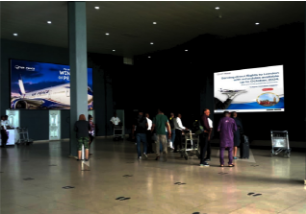
Digital Out-of-Home (DOOH) advertising is reshaping the Nigerian billboard market.
DOOH allows:
-
Dynamic and animated content
-
Multiple advertisers on a single screen
-
Time-based scheduling
-
Remote content updates
This flexibility improves inventory utilization and revenue yield per site. As power infrastructure and connectivity improve, DOOH adoption is expected to accelerate.
Strategic Role of Billboards in Brand Positioning
Billboards function as credibility anchors.
A brand consistently visible in high-traffic locations appears established, stable, and trustworthy. This effect is especially powerful in sectors like banking, telecoms, fintech, FMCG, and real estate.
Billboards also reinforce omnichannel strategies. They amplify digital campaigns by grounding them in the physical world, increasing recall and legitimacy.
Industry Challenges and Constraints
Despite strong growth, the industry faces ongoing challenges:
-
Difficulty in precise ROI measurement
-
High infrastructure and maintenance costs
-
Regulatory complexity
-
Inflation and currency volatility
-
Energy supply constraints
However, these challenges also limit oversupply, preserving the value of premium locations.
Long-Term Outlook for Billboard Advertising in Nigeria
Future growth will be driven by:
-
Continued urban expansion
-
Increased adoption of DOOH technology
-
Better traffic and audience data integration
-
Intensifying brand competition
-
Infrastructure development
As cities grow and mobility remains central to daily life, demand for physical visibility will persist.
Final Analysis
The Nigerian billboard advertising market is a fast-growing, infrastructure-backed media sector deeply embedded in the country’s urban and economic fabric.
It thrives because human movement, city expansion, and brand competition continuously generate demand for visibility. Billboards are not optional add-ons; they are strategic tools for dominance in physical space.
As digital technology integrates with outdoor media and urban corridors expand, the scale, sophistication, and strategic importance of billboard advertising in Nigeria will continue to increase.
In Nigeria, billboard advertising is not just marketing.
It is urban presence, territorial visibility, and competitive signaling at scale.